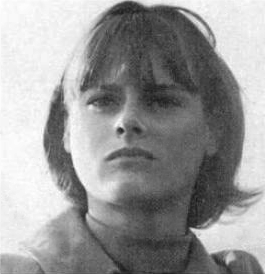
1933 Big Leon Brooks*
1948 Bob Beach*
1955 Chris Cain*
1964 Little Johnny Jones+
1965 Mike Osborn*
1970 Mike Zito*
1948 Bob Beach*
1955 Chris Cain*
1964 Little Johnny Jones+
1965 Mike Osborn*
1970 Mike Zito*
Happy Birthday
Mike Zito *19.11.1970

Mit dem Blues aus dem eigenen Sumpf gezogen
Als Mike Zito 2009 den Blues Music Award gewonnen hatte, wusste er, dass nun alles gut war. Der 1970 in St. Louis geborene Musiker führte lange ein Musikerleben mit allen Klischees, was verbotene Substanzen betrifft. Ein Lebenswandel, der ihn schließlich auf kriminelle Bahnen brachte.
Doch das ist lange her, und seitdem Mike Zito sich auf sein herausragendes Gitarrenspiel und seinen Gesang konzentriert, läuft es bei ihm wieder rund. Mit seiner Mischung aus traditonellem elektrischen Blues, New Orleans Funk und Rock'n'Roll war er auch treibende Kraft der Royal Southern Brotherhood. Nach dem Ausstieg aus diesem Projekt macht Mike Zito jetzt wieder sein eigenes Ding.
Beim 23. Grolsch Blues Festival Schöppingen gelang ihm ein energiegeladener, großformatiger Auftritt.
Mike Zito (born November 19, 1970) is an American guitarist, singer, producer, and songwriter from St. Louis, Missouri. He is a co-founder of Royal Southern Brotherhood that features Cyril Neville, Devon Allman, Charlie Wooton and Yonrico Scott.[1]
Zito started singing at the age of five and by his late teens he had begun his career in the St Louis area music scene. In 2008, Zito made his international debut on the Eclecto Groove label.
Career
Zito released records on his own label he toured regionally and performed some national dates until signing with Eclecto Groove Records in 2008. In 2008 Eclecto Groove Records released Today.
Today was produced by David Z. The musicians on the CD were a line-up of studio musicians that includes bassist James "Hutch" Hutchinson (Bonnie Raitt, Boz Scaggs, Joe Cocker); Heartbreakers and Mudcrutch keyboardist Benmont Tench; co-producer/drummer Tony Braunagel (Taj Mahal, B.B. King) and percussionist Michito Sanchez (Nelly Furtado, Steve Winwood). Also appearing on the CD are Joe Sublett (saxophone), Darrell Leonard (trumpet), Mitch Kashmar (harmonica) with Teresa James and Ce Ce Bullard (background vocals).[3]
In 2009, Eclecto Groove released his second CD Pearl River. Zito and Cyril Neville collaborated on the title track. At the 2010 Blues Music Awards, "Pearl River" won "Song of the Year".[4] Pearl River was recorded in New Orleans, Louisiana at Piety Street Studios. It featured Cyril Neville, Anders Osborne, Reese Wynans, Susan Cowill, Lynwood Slim and Jumpin’ Johnny Sansone, with the rhythm section of Lonnie 'Popcorn' Trevino Jr. (bass) and Eric Bolivar (drum).[5]
In 2011, Zito fulfilled his recording contract with Delta/Eclecto Groove with the release of Greyhound. Greyhound was nominated for "Best Rock Blues Album" at the 2011 Blues Music Awards in Memphis, Tennessee.[6]
In 2013, Mike Zito signed with Ruf Records and released "Gone to Texas" a deep and personal CD dedicated to the state that he say's saved his life.[7] On "Gone to Texas" Mike assembled his band the Wheel which features Zito – guitars and vocals, Scot Sutherland – bass, Jimmy Carpenter – guitars/sax, and Rob Lee on drums.[8]
Royal Southern Brotherhood
Mike Zito was in Royal Southern Brotherhood from 2010 to 2014. [9]
Zito met Devon Allman while working together at the Guitar Center in St. Louis. The two would be reunited again through manager Rueben Williams, who managed Neville and Zito prior to signing Allman.[10]
Zito, Cyril Neville, and Devon Allman became Royal Southern Brotherhood. The three invited rhythm section in Charlie Wooten on bass and drummer Yonrico Scott to do a short tour and the band's first official show was at the “Rock n’ Bowl” in New Orleans. A year slipped by and the supergroup released their debut album to rave reviews.[11]
With Jim Gaines as producer (Carlos Santana, Stevie Ray, The Steve Miller Band) Royal Southern Brotherhood recorded the bands debut album at Dockside recording Studio in Maurice, Los Angeles.[12] Allman, Neville and Zito share lead vocals for the new album creating Zito and Allman play twin guitar leads that is one reminder of the band's related sound to the dual guitar leads played by Allman's uncle, Duane, and Dickey Betts in the Allman Brothers Band.[13]
In May 2014 Royal Southern Brotherhood won the Blues Music Award for "Best DVD" for the band's Ruf Records release "Songs from the Road- Live in Germany"[14]
In June of 2014 Royal Southern Brotherhood released their second studio CD "heartsoulblood" on Ruf Records.[15] Making the Scene described the Cd as " Combining blues and soul the way they do down in N’awlins, the whole is greater than the sum of its parts." This fabulous album was produced by Jim Gaines and engineered by David Z.[16]
In early October 2014 Mike Zito left Royal Southern Brotherhood in order to focus on his own career. [17]
Film and television
In 2012 Zito's "Roll On", from the album Greyhound, was featured on FX's hit series Sons of Anarchy[18]
Solo work
In 2012, Zito debuted his new band, "The Wheel."[19] The Wheel features Scot Sutherland on bass, drummer Rob Lee, and Jimmy Carpenter on saxophone. In 2014, Mike Zito and the Wheel's album, Gone To Texas, was nominated for a Blues Music Award in the 'Rock Blues Album of the Year' category.
Big Leon Brooks *19.11.1933
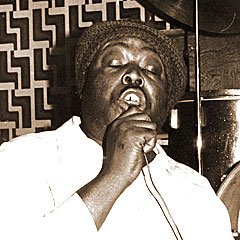
Big Leon Brooks’ deep voice and heavy harmonica tone harkened back to Chicago blues of the 1950s—his style having been preserved by a long hiatus from music. He was influenced very little by the funkier, guitar-driven blues of the ‘60s and ‘70s. Leon was quick to point out that there were better harmonica players years ago. “We had quite a few harmonica players back then that were pretty damn good…. they had more weight, more tone. You got to really blow from within; you’ve got to have that feeling for music, blues music. This is something you don’t find many harp players with today.”
“The Big Man,” as he was aptly called around his home (he often wore shirts with “Big” embroidered on the pocket instead of his name), began playing harp when he was six years old. Growing up in Sunflower, Mississippi, he had a chance to learn from the masters. Leon recalled meeting Sonny Boy Williamson (Rice Miller), Elmore James, Boyd Gilmore and Charlie Booker. “I was raised up around those guys,” he remembered, “but I really learned a lot from the radio, too.”
Moving to Chicago in the early 1940s, Leon began playing with “kids in the neighborhood, on the street and down in Jewtown” (the Maxwell Street outdoor market). There he met his future mentor, Little Walter Jacobs. “I started out in Rice Miller’s style, but Little Walter was really my idol on harmonica, and I followed him around a lot. He was my coach.”
Still a teenager, Leon began slipping into the blues clubs, hanging around mostly at The Zanzibar, where he sat in with the Muddy Waters band. During the early ‘50s, he played with Freddie King and Jimmy Lee Robinson, before forming his first band with guitarist Charles Pearson in 1953. The pair joined Jimmy Rogers’ band for a couple years, before Leon split off to form his own group again. He kept bands together off and on, and worked as a sideman with Willie Johnson, Kansas City Red, Floyd Jones, Otis Rush and Robert Nighthawk throughout the ‘50s.
Then, in the early ‘60s, disenchanted with the more guitar-dominated sound of modern blues, Leon retired from music. “It got to a point where we couldn’t get no gigs. I said ‘the hell with it’, and started strictly working, driving a truck. I didn’t even go to a club.” Nearly fifteen years passed before Leon, after repeated coaxing from the West Side singer called Tail Dragger, decided to re-enter music in 1976. Guitarist Paul Cooper soon brought Leon to the North Side, and in 1977 the harpist began a Sunday night gig at Kingston Mines that lasted almost a year. Then Leon returned to the West Side, working with Tail Dragger, Eddie Taylor and James Scott at Mary’s, The Golden Slipper and The Show & Tell. He was back on the North Side with Scott at the Broadway Night Club before being hospitalized in November 1979 with a heart condition.
He made his recording debut on Alligator’s Living Chicago Blues series in 1980, recording four tracks with an all-star band. He went on to cut a full album, Let’s Go To Town, for the small Blues Over Blues label. Leon died in 1982, at the age of 49, still known only to a small number of hard-core blues fans who love the sound of classic, 1950’s-style Chicago blues.
Mike Osborn *19.11.1965

Mike Osborn und seine "In The Dog House"-Belegschaft lassen nicht unerheblich die Blues-Schwarte krachen. Mit Geschwindigkeit und Gefühl geht man zur Sache und der Frontmann ist mit allen möglichen Saiten-Künsten gesegnet. Die elf Nummern bieten sehr gute Unterhaltung und es entstehen keine Gräben zwischen dem Songwriting eines Alan Mirikitani/Dennis Walker beziehungsweise Mike Osborn.
Ein gewisser Live-Charakter schwingt bei den Liedern immer mit. Mike Osborn serviert uns mit seiner Gitarre und Stimme starke Aussagen in Sachen Blues Rock und bei so versierten Musikern kommt Freude auf. Der Protagonist spielte unter anderem in Stevie Ray Vaughan-Tribute Shows. Hier und da kommt bei Mike Osborn der typische Tone des verstorbenen Texas-Bluesers zum Vorschein. Nicht schlecht, Herr Specht!
Ein Grund, warum man noch relativ wenig über den tollen Musiker gehört hat, ist seine musikalische Pause, die er sich wegen der Familie und besonders seines Sohnes genommen hat. Gut, dass der klasse Gitarrist wieder am Start ist und mit "In The Dog House" ein Knaller-Album veröffentlicht hat.
Der Kreis von Genre-Ablegern ist ziemlich groß. Wenn der Boogie auf den Blues-Weg gebracht wird und der Frontmann mit rauchig-rauer Stimme seinen Text singt, dann erscheint in der Kurve der guten Laune ein Peak, den Mike Osborn auch bei der Country Blues-Auslage seiner Musik erzeugt. Der Boogie ist ja immer eine infizierende Spielart und so ist es auch hier. Blues zum Bewegen und Abfeiern. Der Verstärkerregler hat nicht nur hier die 'Nachbarn-hören-mit'-Einstellung. Super!
Knackige Gitarrenriffs machen gemeinsame Sache mit tollen Refrains und wenn dann zusätzlich noch Breaks oder an- beziehungsweise abschwellende Dynamik ins Spiel kommt, hat der Hörspaß außerplanmäßige Fütterungszeiten.
Bewegt Mike Osborn mit seinem Fuß das Wah Wah-Pedal, pendeln seine Saiten-Ambitionen zwischen leichter Psychedelic sowie Funk. Die Liebe ist bei ihm wie "Fire & Gasoline" und das Stück hat definitiv zündende Wirkung. Die Gitarrenriffs rocken wie Blitze durch die Luft und es wird dabei kräftig mitgeklatscht.
Ein gewisser Live-Charakter schwingt bei den Liedern immer mit. Mike Osborn serviert uns mit seiner Gitarre und Stimme starke Aussagen in Sachen Blues Rock und bei so versierten Musikern kommt Freude auf. Der Protagonist spielte unter anderem in Stevie Ray Vaughan-Tribute Shows. Hier und da kommt bei Mike Osborn der typische Tone des verstorbenen Texas-Bluesers zum Vorschein. Nicht schlecht, Herr Specht!
Ein Grund, warum man noch relativ wenig über den tollen Musiker gehört hat, ist seine musikalische Pause, die er sich wegen der Familie und besonders seines Sohnes genommen hat. Gut, dass der klasse Gitarrist wieder am Start ist und mit "In The Dog House" ein Knaller-Album veröffentlicht hat.
Der Kreis von Genre-Ablegern ist ziemlich groß. Wenn der Boogie auf den Blues-Weg gebracht wird und der Frontmann mit rauchig-rauer Stimme seinen Text singt, dann erscheint in der Kurve der guten Laune ein Peak, den Mike Osborn auch bei der Country Blues-Auslage seiner Musik erzeugt. Der Boogie ist ja immer eine infizierende Spielart und so ist es auch hier. Blues zum Bewegen und Abfeiern. Der Verstärkerregler hat nicht nur hier die 'Nachbarn-hören-mit'-Einstellung. Super!
Knackige Gitarrenriffs machen gemeinsame Sache mit tollen Refrains und wenn dann zusätzlich noch Breaks oder an- beziehungsweise abschwellende Dynamik ins Spiel kommt, hat der Hörspaß außerplanmäßige Fütterungszeiten.
Bewegt Mike Osborn mit seinem Fuß das Wah Wah-Pedal, pendeln seine Saiten-Ambitionen zwischen leichter Psychedelic sowie Funk. Die Liebe ist bei ihm wie "Fire & Gasoline" und das Stück hat definitiv zündende Wirkung. Die Gitarrenriffs rocken wie Blitze durch die Luft und es wird dabei kräftig mitgeklatscht.
Michael W. Osborn was born in Illinois and grew up in the country on the bank of the Kankakee river, not unlike Huckleberry Finn hiking, hunting and fishing, enjoying the outdoors. His family listened to country music and “blue grass” often, He hated it at the time but it would later have a big influence on him musically. When he was 13 his family moved to Woodland CA (near Sacramento), he started taking guitar lessons in school. By the time he was 16 he was performing regularly in local clubs as a lead guitarist in a country rock band. From there he went on to play in rockabilly and metal bands for years and played in church frequently. In 1991 he played professionally for a couple years doing blues and classic rock and become influenced by the recently deceased Stevie Ray Vaughan. After taking a hiatus from music for a few years to focus on raising his children as a single father, Mike started back up again in October 2006 performing weekly and building up a network of musicians and music and re-establishing his reputation. Mike has received rave reviews on magazine, television and radio. Always performing with a raw "edge of the envelope" passion and supported by the finest professional musicians, these shows are a definite must see. October 09' marked the release of his first feature album "Fire & Fury" (a term used to describe the energy of his live performances), a 10 track CD that is a unique blend of blues, rock, country and R&B. The original tracks on the album offer a rare glimpse into his personal views and thoughts on life. In 2014 Mike followed up with his second CD release “In the dog House” named after the studio he recorded it in. The 11 track CD was immediately heralded to glowing reviews. It showcases the musical growth and developing songwriting as Mike continues down his musical path. Mike uses Epiphone guitars and Egnater amps and GHS strings now.
Mike Osborn has been played on over 270 radio stations worldwide, throughout 12 countries including the USA. In the SF Bay Area, he has strong relations with several local blues stations and 107.7FM “The Bone”; all of who support his music and advertise upcoming shows.
His music has been downloaded online tens of thousands of times as of this writing, and he currently holds the #1 spot in the Blues/Rock category of Reverbnation's charts for the Bay Area. He reached #16 on the Roots Report radio playlist after the release of his CD “Fire & Fury” in 2009.
Mike was listed as #1 in the international European based chart “hit tracks-top 100” for week 51 in 2014.
Veteran hit producing R&B artist Lord Luther of the Four Deuces describes Mike Osborn as "blues with a bite" and dubbed him "Vanilla Soul".
Michael W. Osborn-guitar and vocals
Mike has been entertaining crowds since the age of sixteen with his fretboard wizardry and soulfull, growling vocals. He has performed across the country - Austin, Chicago, Los Angeles and is now based out of San Jose CA. where he is well known and highly respected in the musical community and has performed at many of the most prestigious venues in the area. Mike is endoresed by Epiphone guitars, Egnater amps and GHS strings.
http://www.reverbnation.com/mikeosbornband
MIKE OSBORN BAND live at The Turf Club in Heyward CA
Bob Beach *19.11.1948

https://www.facebook.com/bobbeach/photos_albums
Bob Beach has been a working professional musician for more than 40 years, adding harmonica, flute and vocals to a broad scope of genres. Bob is currently available for studio and live performance work in the Philadelphia area as well as nationally. A native Philadelphian, Bob relocated to Western PA after high school. From 1976 to 1997 Bob worked in bands and other musical projects based in the city of Pittsburgh. Since returning to Philadelphia in 1997 Bob has been a vital part of the local music scene. A volunteer at the Philadelphia Folk Fest since 1998 Bob has also has also performed at the fest many times since 2002. He leads the official campfire open mic each year. As a sideman he has recorded or performed with both local and national acts such as; Ollabelle, Langhorne Slim, the Avett Brothers, Pat Wictor, Beaucoup Blue, Fruit and many more. Bob performs live with the Bob Beach Trio, Mason Porter, Lizanne Knott, Wyldlyfe, Hezekiah Jones, Spinning Leaves, the Cat’s Pajamas, Philadelphia Jug Band, the Youngers, Hoots and Hellmouth, David Jacobs-Strain, and others. David and Bob recently released “Live From the Left Coast” recorded in Eugene, Oregon. Bob also is a sound engineer at The World Café Live music venue and books artists for the Lansdowne Folk Club, Concerts at the Beach House and other events and venues in the Philadelphia area.
https://www.reverbnation.com/bobbeach
David Jacobs-Strain (Slide Guitar) Bob Beach (Harmonica), House Concert: Charlotte, NC 6/8/14
David Jacobs-Strain is a fierce slide guitar player, and a song poet
from Oregon. He's known for both his virtuosity and spirit of emotional
abandon; his live show moves from humorous, subversive blues, to
delicate balladry, and then swings back to swampy rock and roll. It's a
range that ties Jacobs-Strain to his own generation and to
guitar-slinger troubadours like Robert Johnson and Jackson Browne. "I
try to make art that you can dance to, but I love that darker place,
where in my mind, Skip James, Nick Drake, and maybe Elliot Smith blur
together."
David Jacobs-Strain has appeared at festivals from British Columbia to Australia, including Merlefest, Telluride Blues Festival, Philadelphia Folk Festival, Hardly Strictly, Bumbershoot, and Blues to Bop in Switzerland. He's taught at Jorma Kaukonen's Fur Peace Ranch, and at fifteen years old was on the faculty at Centrum's Blues and Heritage workshop. On the road, he's shared the stage with Lucinda Williams, Boz Scaggs (more than 60 shows), Etta James, The Doobie Brothers, George Thorogood, Robert Earle Keen, Todd Snider, Taj Mahal, Janis Ian, Tommy Emmanuel, Bob Weir, T-Bone Burnett, and Del McCoury.
Bob Beach
Bob Beach has been a working professional musician for more than 40 years, adding harmonica, flute and vocals to a broad scope of genres. A native Philadelphian, Bob relocated to Western PA after high school. From 1976 to 1997 Bob worked in bands and other musical projects based in the city of Pittsburgh. Since returning to Philadelphia in 1997 Bob has been a vital part of the local music scene. A volunteer at the Philadelphia Folk Fest since 1998 Bob has also has also performed at the fest many times since 2002. David and Bob recently released "Live From the Left Coast" recorded in Eugene, Oregon. Bob also is a sound engineer at The World Café Live music venue and books artists for the Lansdowne Folk Club, Concerts at the Beach House and other events and venues in the Philadelphia area.
David Jacobs-Strain has appeared at festivals from British Columbia to Australia, including Merlefest, Telluride Blues Festival, Philadelphia Folk Festival, Hardly Strictly, Bumbershoot, and Blues to Bop in Switzerland. He's taught at Jorma Kaukonen's Fur Peace Ranch, and at fifteen years old was on the faculty at Centrum's Blues and Heritage workshop. On the road, he's shared the stage with Lucinda Williams, Boz Scaggs (more than 60 shows), Etta James, The Doobie Brothers, George Thorogood, Robert Earle Keen, Todd Snider, Taj Mahal, Janis Ian, Tommy Emmanuel, Bob Weir, T-Bone Burnett, and Del McCoury.
Bob Beach
Bob Beach has been a working professional musician for more than 40 years, adding harmonica, flute and vocals to a broad scope of genres. A native Philadelphian, Bob relocated to Western PA after high school. From 1976 to 1997 Bob worked in bands and other musical projects based in the city of Pittsburgh. Since returning to Philadelphia in 1997 Bob has been a vital part of the local music scene. A volunteer at the Philadelphia Folk Fest since 1998 Bob has also has also performed at the fest many times since 2002. David and Bob recently released "Live From the Left Coast" recorded in Eugene, Oregon. Bob also is a sound engineer at The World Café Live music venue and books artists for the Lansdowne Folk Club, Concerts at the Beach House and other events and venues in the Philadelphia area.
Chris Cain *19.11.1955

Chris Cain (born November 19, 1955, San Jose, California, United States)[1] is an American blues and jazz guitarist with an international following.
He began playing professionally as a teenager in local clubs, at festivals, and at private events.
Cain received four Blues Music Award nominations in 1987 for his debut album, Late Night City Blues, including Guitarist of the Year. He signed to Blind Pig Records in 1990 and released his second album, Cuttin' Loose, then released Can't Buy A Break in 1992 and Somewhere Along the Way in 1995.
https://en.wikipedia.org/wiki/Chris_Cain
Chris Cain's jazz-tinged, blues soaked guitar and deep, warm vocals have the maturity and authenticity of bluesmen many years his senior. His expressive style is the result of a lifetime of study and the relentless pursuit of music mastery. His passion and intensity are a blend of his mother's Greek ancestry and his father's soulful black heritage.
Cain was raised on stories of his father's childhood upbringing on Memphis' Historic Beale Street and attended his first B.B King concert at the tender age of three. Blues music played continuously on the home stereo and family outings were often trips to concerts. Cain recalls, "I remember when I was a kid, my Dad would be mowing the lawn with the stereo blasting Muddy Waters. When I look back, that was pretty cool! There was always music playing at our house, Ray Charles, B.B. King, Freddie King, Albert King, all the greats."
Chris Cain and GuitarAt the age of eight, Cain taught himself to play guitar and began playing professionally before he was eighteen. Chris studied music at San Jose City College, and was soon teaching jazz improvisation on campus. Over the next twenty years, Cain would also master piano, bass guitar, clarinet, alto and tenor saxophone. The combination of his blues upbringing and his jazz studies melded to form the searing guitar style that sets Chris Cain apart and has moved him to the top ranks of the blues music scene.
Cain's debut recording, Late Night City Blues (Blue Rock'it Records-1987) garnered four W.C. Handy Blues Award nominations, including Guitarist of the Year." Dan Forte of Guitar Player wrote, "An impressive debut album by a top notch guitarist." Cain's next two releases; "Cuttin Loose" (Blind Pig Records-1990) and "Can't Buy a Break" (Blind Pig Records-1992) collected a long list of awards and accolades. In August of 1995 Blind Pig released "Somewhere Along the Way" his 4th compilation of his unique brand of original music sophisticated blues, funk, jazz and gospel.
In 2003 Patrick Ford produced Chris's latest CD, "Hall Of Shame" (Blue Rock'it Records-2003). "...this is now the sixth Chris Cain solo release I have produced, not to mention his work with me on projects like the Ford Blues Bands' "In Memory Of Michael Bloomfield" CD, and I continue to be in awe of his incredible talent. As a guitarist/singer, Chris has been praised by mentors like Albert King and peers like Robben Ford."
Larry Nager (syndicated Scripts-Howard music critic) writes, "Nowadays most young blues players are Strat-wielding Stevie Ray Vaughan-a-bes. Not Chris Cain. With a voice that recalls B.B. King and a thick toned Gibson guitar sound reminiscent of Albert King, Cain is forging a unique style. With his own highly personalized songwriting, "Hall Of Shame" is a giant step in the development of one of the most compelling young bluesmen on today's scene." Cain at JJs
Through his guitar mastery and remarkable songwriting ability, Chris Cain has established himself as a musical force to be reckoned with. And as San Jose Mercury News music reviewer John Orr writes, "more than anyone else, anywhere, Chris Cain represents the future of the blues."
http://www.chriscainmusic.com/Cain_history.html
Chris Cain Narooma Blues Festival 2005
CHRIS CAIN & BAND, 'MY BABY WANTS TO LEAVE ME', BISCUIT & BLUES, SAN FRANCISCO, FEB. 16TH, 2016
R.I.P.
Little Johnny Jones +19.11.1964
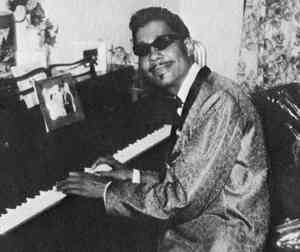
Little Johnny Jones (* 1. November 1924 in Jackson, Mississippi; † 19. November 1964 in Chicago, Illinois) war ein US-amerikanischer Pianist und Sänger, der besonders durch seine Arbeit mit Muddy Waters und Elmore James bekannt wurde.
Jones wurde in eine musikalische Familie hinein geboren, seine Mutter spielte Klavier in Kirchen in Jackson und sein Vater spielte Gitarre und Harmonika. Aber sein größter Einfluss, wie bei vielen Pianisten aus Chicago, war Big Maceo Merriweather, der in unter seine Fittiche nahm und ihn auch als "Sohn" bezeichnete. [1]Jones kam 1946 aus Mississippi nach Chicago und etablierte sich bald als gesuchter Musiker. Nachdem Big Maceo Merriweather einen Schlaganfall hatte, der seine Hand lähmte, ersetzte Johnny Jones ihn in der Band von Tampa Red. Als Pianist war er auf seinen Aufnahmen von 1949 bis 1953 zu hören. Ebenso war er auf "Screamin' and Cryin'" von Muddy Waters zu hören und auf Aufnahmen von Howlin' Wolf. Von 1952 bis 1956 unterstützte er Elmore James bei seinen Aufnahmen und bildete mit ihm, dem Saxophonisten J .T. Brown und dem Drummer Odie Payne die "Broomdusters" die zahllose Aufnahmen für Meteor, Flair, Chief, Chess, Vee Jay und Fire aufnahmen.Bei "Flip, Flop & Fly" spielte er Klavier für Big Joe Turner.[1] Er spielte oft im Sylvio's, dem wichtigsten Klub in Chicagos Westside. Dort spielten drei Bands am Abend und oft saß Jones bei allen drei am Klavier. [1]1949 nahm er seine erste Single "Big Town Playboy" für Aristocrat auf. Auf dieser Aufnahme wurde er von Muddy Waters, Jimmy Rogers, und Leroy Foster begleitet. Der Titel wurde 1955 vom Gitarristen Eddie Taylor neu aufgenommen. Neben seinen pianistischen Fähigkeiten war auch seine Stimme packend.[2] Bis 1953 nahm er selbst noch zwei Singles auf. Danach war er, bis zu seinem Tod 1964 wieder in Clubs und als Sessionmusiker tätig, unter anderen mit Howlin' Wolf, Sonny Boy Williamson, Syl Johnson, Billy Boy Arnold und Magic Sam.
Bruce Iglauer meint in den Linernotes zu "Live in Chicago with Billy Boy Arnold", dass, wenn er bis in die 1970er - Jahre gelebt hätte, sein Ruhm mit dem von Otis Spann konkurrieren hätte können.[1] Und Bill Dahl meint im All Music Guide, dass er einer der größten Pianisten war, die jemals in Chicago gelebt haben. [2] Johnny Jones starb am 19. November 1964 an Lungenkrebs.
Little
Johnny Jones is a musical by George M. Cohan. The show introduced
Cohan's tunes "Give My Regards to Broadway" and "The
Yankee Doodle Boy." The "Yankee Doodle" character was
inspired by real-life Hall of Fame jockey Tod Sloan.
Background
The show was Cohan's first full-length musical. A famous American jockey, Tod Sloan, had gone to England in 1903 to ride in the Derby for King Edward VII of England. This gave Cohan the idea for the story. The musical is patriotic in tone and contains a number of quips aimed at European targets, such as, "You think I'd marry an heiress and live off her money? What do you take me for? An Englishman?" and, "French pastry ain't worth 30¢ compared to American apple pie." In Little Johnny Jones Cohan introduced some of the dance steps and comedy features for which he would become famous.[1]
This musical is also credited as being the first American Musical, along "with The Black Crook, Evangeline, Show Boat" ... or any number of other works."[2] (The Black Crook (1866) is considered a prototype of the modern musical in that its popular songs and dances are interspersed throughout a unifying play and performed by the actors.[3])
Synopsis
A brash, patriotic American jockey, Johnny Jones, goes to England to ride his horse, Yankee Doodle, in the English Derby. Jones falls in love with Goldie Gates, a San Francisco copper heiress, who follows him to Britain, disguising herself as a man to discover if Jones really loves her. Anthony Anstey, an American who runs a Chinese gambling establishment in San Francisco, offers Jones a bribe to lose the race deliberately, but he refuses. After Jones loses, Anstey spreads rumors that he threw the race intentionally. Jones' detective, pretending to be a drunkard, searches for evidence to clear Johnny's name and finds out that it was Anstey that framed Jones. Jones tells his friends who are returning to America, "Give My Regards to Broadway," but he stays in London to try to regain his reputation. Jones returns to America with his name cleared, eager to propose marriage to Goldie, but he finds that Anstey has kidnapped her. He and his detective search for her in San Francisco's Chinatown, eventually finding her.
Original production
The musical was first tried out at the Parsons Theatre in Hartford, Connecticut in October 1904 and then opened on Broadway at the Liberty Theatre on November 7, 1904. The original production was produced by Sam H. Harris and directed by George M. Cohan who also performed as part of the cast with the other members of The Four Cohans (Cohan, his parents and sister). Ethel Levey, Cohan's wife, co-starred.[4] Among the other performers were William Seymour and Donald Brian. The Broadway run of only 52 performances was followed by tours, during which some rewrites were made. It was revived twice in 1905 at the New York Theatre, playing successfully for over 200 performances through most of that year, and touring until the next Broadway revival in 1907 for a short run at the Academy of Music. The production was mounted with a huge cast.[5]
Subsequent adaptations and productions
Little Johnny Jones was adapted twice for the motion pictures, first as a silent film released in 1924 by Warner Bros.[6] First National followed this in 1929 with an early talkie musical version directed by Mervyn LeRoy, who played a bit part in the 1924 film. Eddie Buzzell, who co-wrote the screenplay with Adelaide Heilbron, played the title role. Only two of Cohan's original songs survived the transition to the screen ("Give My Regards To Broadway" and "Yankee Doodle Boy"). The five other tunes in the film's score were contributed by various other songwriters, mainly Herb Magidson and Michael H. Cleary.[7]
James Cagney appeared in a play-within-a-play staging of numbers and dances from Little Johnny Jones in the 1942 film, Yankee Doodle Dandy.
David Cassidy starred in a touring revival in 1981.[8] After previewing at Connecticut's Goodspeed Opera House and touring, a 1982 revival, adapted by Alfred Uhry, closed at the Alvin Theatre after only one performance. It starred Donny Osmond in the lead.
An adaptation of the show was produced by the Light Opera of Manhattan in the late 1980s, called Give My Regards to Broadway and was successful for that company.
Background
The show was Cohan's first full-length musical. A famous American jockey, Tod Sloan, had gone to England in 1903 to ride in the Derby for King Edward VII of England. This gave Cohan the idea for the story. The musical is patriotic in tone and contains a number of quips aimed at European targets, such as, "You think I'd marry an heiress and live off her money? What do you take me for? An Englishman?" and, "French pastry ain't worth 30¢ compared to American apple pie." In Little Johnny Jones Cohan introduced some of the dance steps and comedy features for which he would become famous.[1]
This musical is also credited as being the first American Musical, along "with The Black Crook, Evangeline, Show Boat" ... or any number of other works."[2] (The Black Crook (1866) is considered a prototype of the modern musical in that its popular songs and dances are interspersed throughout a unifying play and performed by the actors.[3])
Synopsis
A brash, patriotic American jockey, Johnny Jones, goes to England to ride his horse, Yankee Doodle, in the English Derby. Jones falls in love with Goldie Gates, a San Francisco copper heiress, who follows him to Britain, disguising herself as a man to discover if Jones really loves her. Anthony Anstey, an American who runs a Chinese gambling establishment in San Francisco, offers Jones a bribe to lose the race deliberately, but he refuses. After Jones loses, Anstey spreads rumors that he threw the race intentionally. Jones' detective, pretending to be a drunkard, searches for evidence to clear Johnny's name and finds out that it was Anstey that framed Jones. Jones tells his friends who are returning to America, "Give My Regards to Broadway," but he stays in London to try to regain his reputation. Jones returns to America with his name cleared, eager to propose marriage to Goldie, but he finds that Anstey has kidnapped her. He and his detective search for her in San Francisco's Chinatown, eventually finding her.
Original production
The musical was first tried out at the Parsons Theatre in Hartford, Connecticut in October 1904 and then opened on Broadway at the Liberty Theatre on November 7, 1904. The original production was produced by Sam H. Harris and directed by George M. Cohan who also performed as part of the cast with the other members of The Four Cohans (Cohan, his parents and sister). Ethel Levey, Cohan's wife, co-starred.[4] Among the other performers were William Seymour and Donald Brian. The Broadway run of only 52 performances was followed by tours, during which some rewrites were made. It was revived twice in 1905 at the New York Theatre, playing successfully for over 200 performances through most of that year, and touring until the next Broadway revival in 1907 for a short run at the Academy of Music. The production was mounted with a huge cast.[5]
Subsequent adaptations and productions
Little Johnny Jones was adapted twice for the motion pictures, first as a silent film released in 1924 by Warner Bros.[6] First National followed this in 1929 with an early talkie musical version directed by Mervyn LeRoy, who played a bit part in the 1924 film. Eddie Buzzell, who co-wrote the screenplay with Adelaide Heilbron, played the title role. Only two of Cohan's original songs survived the transition to the screen ("Give My Regards To Broadway" and "Yankee Doodle Boy"). The five other tunes in the film's score were contributed by various other songwriters, mainly Herb Magidson and Michael H. Cleary.[7]
James Cagney appeared in a play-within-a-play staging of numbers and dances from Little Johnny Jones in the 1942 film, Yankee Doodle Dandy.
David Cassidy starred in a touring revival in 1981.[8] After previewing at Connecticut's Goodspeed Opera House and touring, a 1982 revival, adapted by Alfred Uhry, closed at the Alvin Theatre after only one performance. It starred Donny Osmond in the lead.
An adaptation of the show was produced by the Light Opera of Manhattan in the late 1980s, called Give My Regards to Broadway and was successful for that company.




:format(jpeg):mode_rgb()/discogs-images/A-340682-1265558922.jpeg.jpg)