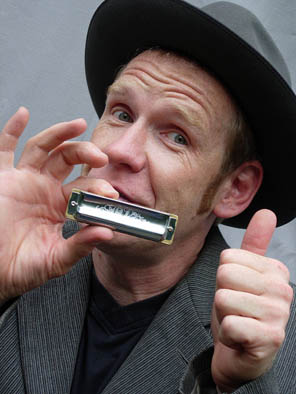
1914 Camille Howard*
1939 Milton Frazier alias Alabama Slim*
1966 Jazz Gillum+
1967 John Popper*
1968 Sue Foley*
1969 Christian Schwarzbach*
1969 Thomas Schied*
1939 Milton Frazier alias Alabama Slim*
1966 Jazz Gillum+
1967 John Popper*
1968 Sue Foley*
1969 Christian Schwarzbach*
1969 Thomas Schied*
Happy Birthday
John Popper *29.03.1967
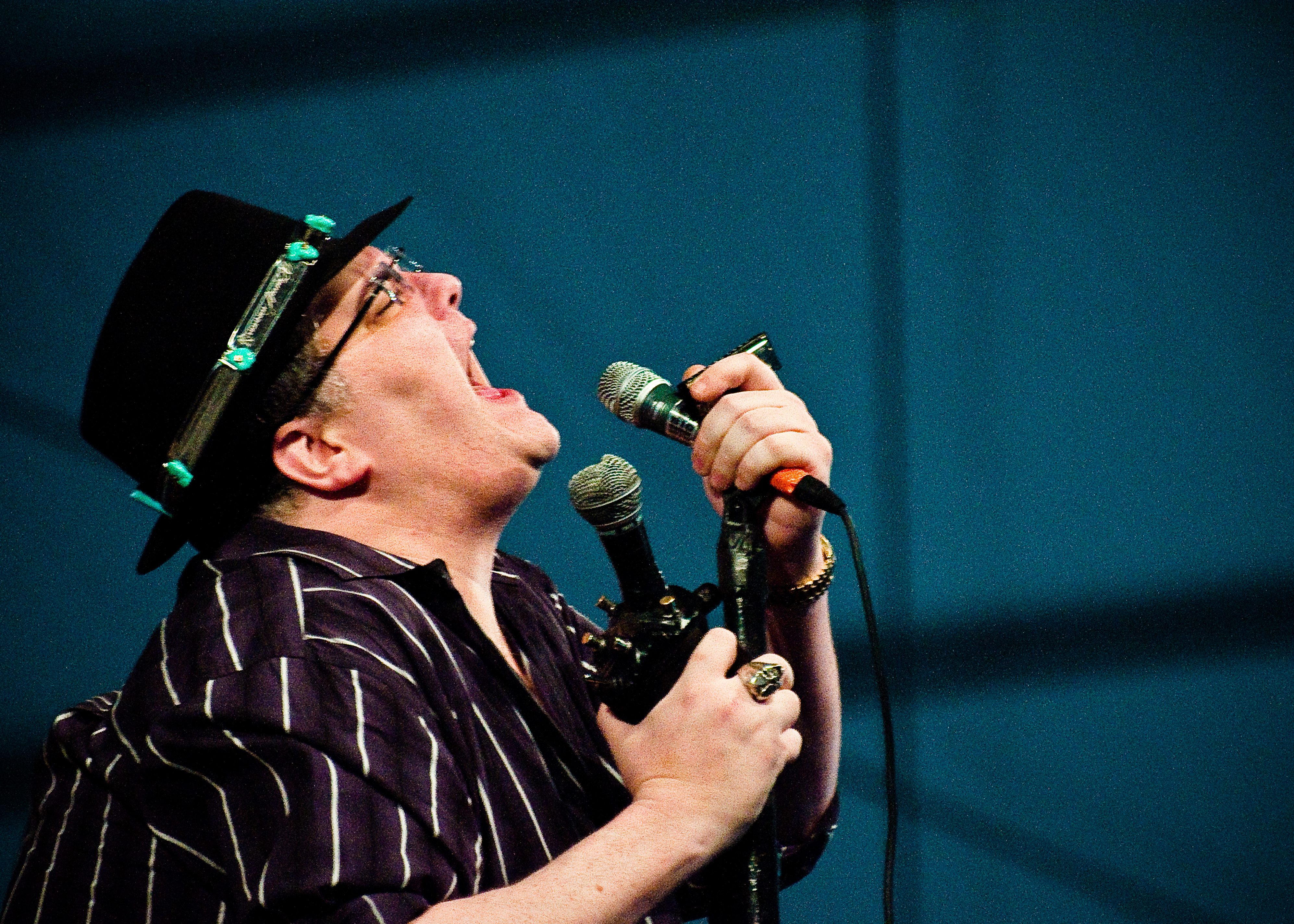
John Popper (* 29. März 1967 in Cleveland, Ohio) ist ein US-amerikanischer Bluesmusiker.
Popper ist als Sänger, vor allem aber als Blues Harp-Spieler der New Yorker Gruppe Blues Traveler bekannt. Er gilt als einer der weltbesten Mundharmonika-Spieler. Von der Firma Hohner wird er als „Featured Artist“ aufgelistet, eine Auszeichnung, die nur den besten und erfolgreichsten Mundharmonikaspielern zuteilwird.
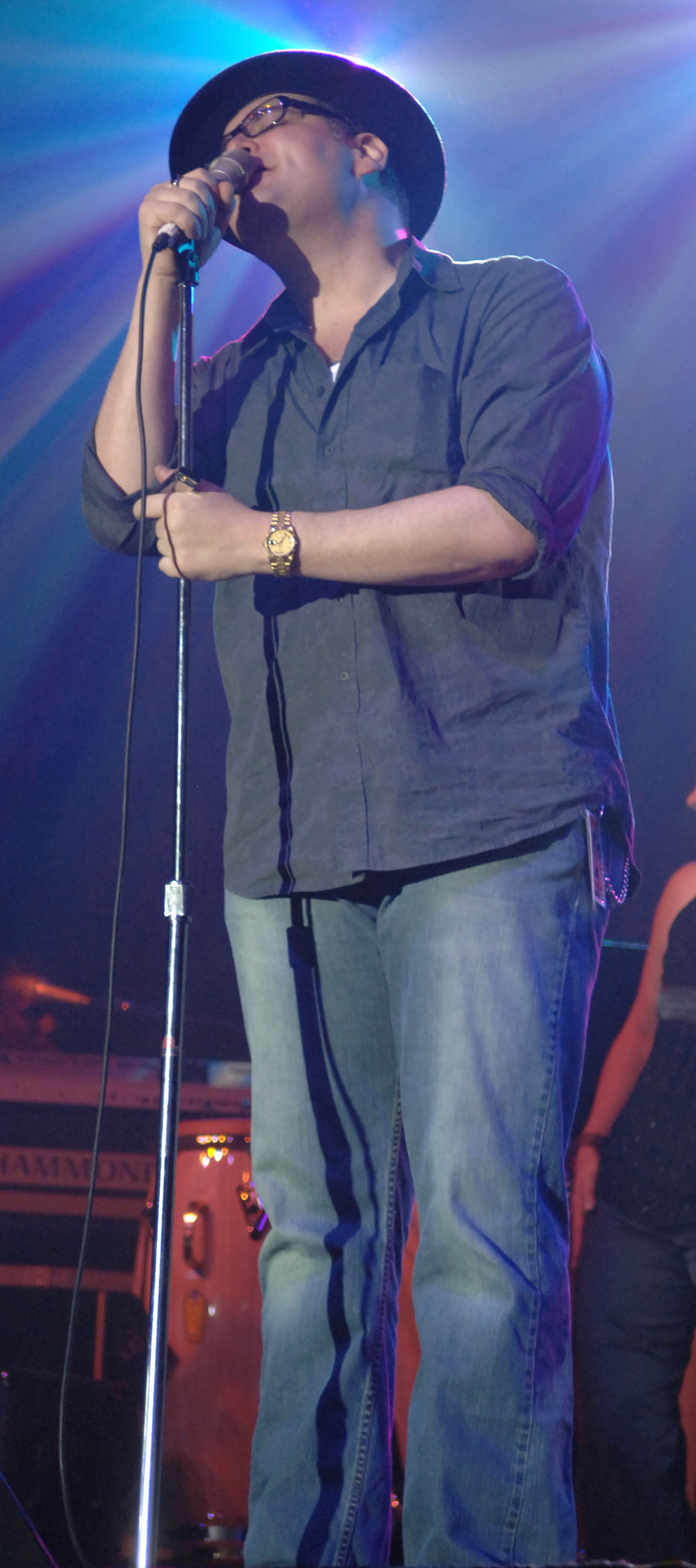 Weitere Aktivitäten:
1987 Gründung einer Band namens Trucking Company zusammen mit Eric Schenkman und dem Schlagzeuger Brendan Hill. Popper verließ diese Band bald wieder, da er bei Blues Traveler einstieg.
1998 Musik zum Film Blues Brothers 2000 zusammen mit Paul Shaffer.
häufig Gastmusiker anderer Bands. (z. B. Metallica)
http://de.wikipedia.org/wiki/John_Popper
John Popper (born March 29, 1967) is an American musician and songwriter.
He is most famous for his role as frontman of rock band Blues Traveler performing harmonica, guitar and vocals. He is widely considered a harmonica virtuoso, and is listed by harmonica manufacturer Hohner as a "Featured Artist", an accolade reserved for only the best and most successful harmonica players.
Early life
John Popper was born in Chardon, Ohio.[1] His father was a Hungarian immigrant who escaped Budapest in 1948.[2] Through him, Popper is related to David Popper, a 19th-century European cellist whose many solo works for the cello are staples of the instrument's repertoire.[3] John's mother and brother are lawyers.[4]
Popper was raised in Stamford, Connecticut, New York, and New Jersey. He attended Davenport Ridge School, Stamford Catholic High School (now Trinity Catholic High School) and Princeton High School. He took lessons on the piano, the cello, and the guitar, but none of those instruments appealed to him and he hated being forced to practice.[5][6]
He originally wanted to become a comedian, finding he could use humor to make friends and avoid bullies,[7] but when he and a friend performed a routine as The Blues Brothers, he found that he enjoyed musical performance. From there, he took up the harmonica. Popper played trumpet in the Princeton High School Studio Jazz Band, and convinced the teacher to let him play harmonica instead, after an in-class solo on the song "She Blinded Me With Science".[5][8]
He formed several garage bands with friends in Princeton, New Jersey, one of which evolved into Blues Traveler in 1987. After graduating from high school, the group's members all moved to New York City, where Popper enrolled in The New School for Jazz and Contemporary Music along with two of his bandmates and high school friend Chris Barron. Popper attended for three years but devoted himself to the band full-time once they signed a record contract in 1990.[5][8]
Career
Blues Traveler
Popper is a founding member of Blues Traveler, serving as the band's front man with lead vocals and harmonica. For some songs, he forgoes the harmonica in favor of guitar, most often a 12-string acoustic. In addition, Popper has played the tin whistle on some recordings.
A prolific songwriter, he has composed the majority of the lyrics and music of Blues Traveler's songs.
The band grew a following with its extensive touring, sometimes with over 300 dates a year, and gained a reputation in the jam band scene of the 1990s. Blues Traveler crossed over into mainstream pop/rock radio success with their 1994 album four, which garnered the group extensive media exposure. The Grammy Award for Best Rock Performance by a Duo or Group with Vocal in 1996 was awarded to "Run-Around", a song that Popper composed.
Solo work
In 1990, Popper began to perform occasional solo concerts in addition to touring with Blues Traveler. Several songs that originated as Popper's solo pieces have become part of Blues Traveler's repertoire, and vice versa.
Bolstered by Blues Traveler's mainstream success, Popper released a solo album, Zygote, in 1999 and toured in support of it with his own John Popper Band. The album was produced by Terry Manning, and the backing band consisted of longtime friends[8] Dave Ares, Crugie Riccio, and Rob Clores of Cycomotogoat, with drummer Carter Beauford of Dave Matthews Band. The album's release came less than three months after his heart surgery, and only days after the death of Bobby Sheehan, Popper's band mate and best friend. The subsequent tour was canceled midway due to poor ticket sales, and Popper instead took the time to focus on his health.[9]
Popper has co-written songs with Trey Anastasio, Warren Haynes, Chris Barron, and Jonny Lang. He also frequently appears as a guest performer with musicians both famous and obscure, from a diverse variety of genres. He has performed with, among others, jam bands Spin Doctors, Dave Matthews Band, Phish and most recently, The Allman Brothers Band in 2009; bluesmen Eric Clapton and B.B. King; singer-songwriters Jason Mraz and John Mayer; saxophonist Karl Denson; San Francisco's Culann's Hounds; heavy metal band Metallica; rock trio ZO2 and even with the Hungarian Ambassador to the United States, András Simonyi. He sat in with The Smashing Pumpkins on the second day of their acoustic 1997 Bridge School Benefit appearance, contributing harmonica for their song "Porcelina of the Vast Oceans"; Popper's solo garnered major applause from the audience. He also performed with the Grateful Dead at a tribute to Bill Graham in 1991. He was the harmonica player on Hanson's album This Time Around in 2000, for which he performed on "If Only" and "In The City."
Side projects
In 1992, Popper conceived the HORDE Festival as a venue to gain exposure for up-and-coming independent musicians. It ran until 1998.
Popper was a part of a one-time studio band brought together in 1997 by New York drummer/songwriter Solomon Deniro. Other players included Trey Gunn, Bernie Worrell, Marc Ribot, and Vernon Reid. The group's only recordings were released as the album Gimme Gimme under the name The Devotees.[10] The same recording was re-released by Deniro in 2001 with the title Solomon.[11]
Popper took over in 1998 as front man of jam-band supergroup Frogwings, which released the live album Croakin' at Toad's. Frogwings was mainly active until 2000.
Recently, Popper formed a rock/jazz/hip-hop fusion group The John Popper Project with DJ Logic, which released an album in 2006 and performs occasionally. He also performs on the album Global Noize by Jason Miles and DJ Logic (2008).
Popper's latest side project is John Popper & the Duskray Troubadours, which plays Americana roots music.[8] The group's self-titled debut from 429 Records was released March 2011 and produced by band member Jono Manson who co-wrote much of the material. The first single, "Something Sweet", written by Manson and Bruce Donnola, was released February 7, 2011 on iTunes.
Acting and media appearances
Popper had a speaking guest role in an episode of the sitcom Roseanne as a musician similar to himself. Popper appeared on Episode 30 of Space Ghost Coast To Coast as a musical guest. Popper appeared as a guest on the IFC television comedy series Z Rock. He plays a role as himself, and befriends the band ZO2, helping them get a record deal. He also played the Star-Spangled Banner prior to Game 4 of the 1996 World Series.
In film, Popper had a cameo role as a bowling tournament MC in Kingpin and also with Blues Traveler as the Amish band singing "But Anyway" at end of movie and an appearance in Howard Stern's Private Parts as himself. Another cameo followed in Blues Brothers 2000, with Blues Traveler appearing on the soundtrack and Popper also recording Buster Blues' (J. Evan Bonifant) harmonica parts for the film. Popper's first major role was in 2000 in Just for the Time Being, an independent film starring Eva Herzigova.
Popper has provided narration for art projects produced by his friends, including Das Clown, an award-winning short film in slideshow style that was screened at the Sundance Film Festival.[12]
Popper served as host of the third annual Jammy awards in 2002.
He has been a recurring guest on Howard Stern's and Bill Maher's shows and sits in with The CBS Orchestra on the Late Show with David Letterman on occasion. In 2009, he sat in with The Roots on an episode of Late Night with Jimmy Fallon. Popper performed "Something Sweet" with the Duskray Troubadours on the TBS show "Lopez Tonight" on March 1, 2011. He also sat in with the house band for the closing number of the show.
Personal life
Since the success of Blues Traveler, Popper has lived in various locations, including rural Pennsylvania and New Orleans. He currently has a residence near Snohomish, Washington.
In October 1992 Popper was involved in a traffic accident on a motorcycle while traveling to a studio to record for Blues Traveler's third album. The accident put him in a wheelchair for several months, but Popper continued touring with the band despite the difficulties it created.
In 1999, he suffered a near-fatal heart attack brought on by years of compulsive overeating. (He had been diagnosed with diabetes a few years earlier.) Doctors at Cedars-Sinai Medical Center[13] performed an emergency angioplasty which saved Popper's life: he had 95% arterial blockage.[14] Popper later underwent gastric bypass surgery and lost a significant amount of weight.[15]
Popper has a tattoo across his chest that says, "I WANT TO BE BRAVE", written backwards.[7][16][17]
Weapons collecting
Popper is an avid collector of weaponry, including firearms, swords, and a working $10,000 American Civil War cannon.[18][19] He cites a fascination with their aesthetic of being "life-savingly efficient" machines.[20][21] Popper is a supporter of Second Amendment rights, and appeared on an MTV-sponsored roundtable discussion on gun control which included panelists from the Law Enforcement Alliance of America and Harvard's John F. Kennedy School of Government.[22] He carries weapons in any state where it is allowed, even wearing them onstage.[23] On his Daily Show appearance, he stated that he decided to move away from New Jersey because of the state's tight gun laws.[24] He said that his Bucks County, Pennsylvania property had 32 acres (13 ha) on which he built a private gun range.
Politics
Popper is a member of the Libertarian Party,[25] and has previously expressed support for the Republican Party.[26] He endorsed George W. Bush in the 2004 U.S. presidential election.[27] In November 2008, Popper said, regarding Barack Obama, "this is the first time I've voted for a Democrat, ever."[28] John Popper was a supporter of Ron Paul during the 2012 Presidential election, even participating in phone-banking at Ron Paul's New Hampshire campaign headquarters.[29] He also played a short set during Ron Paul's "We are the Future Rally", an alternative convention for Paul supporters which was held in Tampa the day before the 2012 Republican National Convention.[30]
Popper (with and without Blues Traveler) has played at conventions, fundraisers, and ceremonies for both Republican and Democratic politicians.[31] He has stated that politics do not influence his choice of performance setting.
Popper has said, "I was a bleeding-heart liberal, until I got a job"[31] and describes himself as "a libertarian who is a Republican when pushed".[20] Popper summed up his political position by saying "I believe in freedom for markets and freedom for individuals, so I guess that makes me a libertarian".[20]
Popper has toured with the USO, both with Blues Traveler and solo.[16] In the mid-2000s, he toured the Middle East, performing with the Band of the Air Force Reserve and Jamie O'Neal at various military camps.
He has appeared with Rock the Vote and recorded "The Preamble" for the Schoolhouse Rocks the Vote! album.
Religion
Popper was raised Catholic, and for a time attended Stamford Catholic High School in Connecticut. However, he does not actively practice in his adult life. He has described himself as a "recovering Catholic". The song "Trina Magna" was written as an exploration of his religious views.[32]
Legal trouble
In 2003, Popper was arrested for possession of marijuana.[33] Popper was arrested again on March 6, 2007 near Ritzville, Washington by the Washington State Patrol.[34] He was the passenger in his own vehicle, which was stopped for speeding, and was found to be in the possession of a small amount of marijuana and weapons. Popper was released the same night. The vehicle had a stash of hidden compartments which contained four rifles, nine handguns, a switchblade knife, a Taser, a set of brass knuckles, and night vision goggles. The vehicle was temporarily seized.[35][36]
No charges were filed for the weapons, as they were all registered and securely locked away, and Popper was licensed to carry them, with the exception of the brass knuckles and switchblade knife which Popper agreed to surrender. A deal was reached that allowed the marijuana charge to be dropped if Popper remained free of further drug infractions for one year and attended eight hours of drug counseling.[37] Popper and the driver had been driving back to Washington from Austin, Texas, and Popper likes to visit gun ranges during long trips.[38]
Equipment
John Popper has expressed a preference for the Hohner Special 20 brand blues harp, calling them "the Porsche of harmonicas".[39]
Popper uses Shure microphones and Mesa Boogie amplifiers, similar to bandmate Chan Kinchla. He also uses D'Addario strings.
Trademark equipment
Popper has developed some equipment innovations to accommodate his use of harmonicas during onstage performances. Because each individual diatonic harmonica is tuned to one particular key, he fashioned belts with enough pockets to hold harmonicas in all 12 keys (plus extras) and wore them as a bandolier, or slung over his neck. He frequently has to switch keys multiple times within one song, and this arrangement allowed him to quickly trade one harmonica for another without looking. In 2002, he stopped using the belts because they no longer fit him properly due to his weight loss; now he carries his harmonicas in a small black attaché case. He uses a special microphone with switches that change the audio effect of the harmonica as it is played through an amplifier, similar to a guitar effects pedal. Popper was inspired by Jimi Hendrix's guitar playing to make his instrument sound however he wanted.[8] He has fashioned a number of floppy-brimmed hats with flattened harmonica cover plates on the band, which he almost always wears during appearances with Blues Traveler.
Blues Traveler ist eine US-amerikanische Blues-Rock-Band aus Princeton (New Jersey).
Karriere
Die Band wurde 1988 von John Popper gegründet. Die erste LP Blues Traveler erschien 1990 und tauchte ein Jahr später in der amerikanischen LP-Hitparade auf. 1991 erschien dann ihre zweite Langspielplatte Travelers and Thieves, die bei Kritikern große Beachtung fand. In dem darauf folgenden Jahr produzierte die Band ihr drittes Album, das von einem schweren Unfall von John Popper überschattet wurde. Dieser verunglückte mit dem Motorrad so schwer, dass er über ein Jahr im Rollstuhl verbringen musste, was ihn aber nicht daran hinderte, mit der Gruppe aufzutreten.
Den größten Erfolg hatten die Blues Traveler mit dem vierten Album four, das 1994 erschien. Im Dezember des Jahres platzierte sich die Platte auf Platz 8 der amerikanischen LP-Hitparade und verkaufte sich über 5 Millionen mal. Gleichzeitig erschien die Single Run Around, die eine Auskopplung der LP war, und landete unter den Top-Ten der Single-Hitparade in den USA. Die zweite Auskopplung aus der LP (Hook) erreichte allerdings Ende 1995 nur Platz 23 der US Single-Charts. 1996 nahm die Band die Live-Doppel-CD Live from the Fall auf, die ihre Qualität als hervorragende Liveband widerspiegelte. 1999 markierte für die Band einen tragischen Wendepunkt: Bassist Bobby Sheehan starb infolge Drogenmissbrauchs, Ben Wilson (Keyboards) und Tad Kinchla (Bass) kamen neu in die Band. In den folgenden Jahren erschienen weitere CDs, die musikalisch das Niveau der Veröffentlichungen in den neunziger Jahren hielten, aber nicht mehr an den Erfolg von four anknüpfen konnten.
In Deutschland sind Blues Traveler praktisch unbekannt. Die meisten ihrer Alben sind hier nicht erschienen und nur als Import zu bekommen. Bekannt sind sie hier mehr durch Beiträge auf Soundtracks amerikanischer Filme; in einigen hatten sie auch Gastauftritte, so beispielsweise in Blues Brothers 2000 oder Kingpin.
https://de.wikipedia.org/wiki/Blues_TravelerKarriere
Die Band wurde 1988 von John Popper gegründet. Die erste LP Blues Traveler erschien 1990 und tauchte ein Jahr später in der amerikanischen LP-Hitparade auf. 1991 erschien dann ihre zweite Langspielplatte Travelers and Thieves, die bei Kritikern große Beachtung fand. In dem darauf folgenden Jahr produzierte die Band ihr drittes Album, das von einem schweren Unfall von John Popper überschattet wurde. Dieser verunglückte mit dem Motorrad so schwer, dass er über ein Jahr im Rollstuhl verbringen musste, was ihn aber nicht daran hinderte, mit der Gruppe aufzutreten.
Den größten Erfolg hatten die Blues Traveler mit dem vierten Album four, das 1994 erschien. Im Dezember des Jahres platzierte sich die Platte auf Platz 8 der amerikanischen LP-Hitparade und verkaufte sich über 5 Millionen mal. Gleichzeitig erschien die Single Run Around, die eine Auskopplung der LP war, und landete unter den Top-Ten der Single-Hitparade in den USA. Die zweite Auskopplung aus der LP (Hook) erreichte allerdings Ende 1995 nur Platz 23 der US Single-Charts. 1996 nahm die Band die Live-Doppel-CD Live from the Fall auf, die ihre Qualität als hervorragende Liveband widerspiegelte. 1999 markierte für die Band einen tragischen Wendepunkt: Bassist Bobby Sheehan starb infolge Drogenmissbrauchs, Ben Wilson (Keyboards) und Tad Kinchla (Bass) kamen neu in die Band. In den folgenden Jahren erschienen weitere CDs, die musikalisch das Niveau der Veröffentlichungen in den neunziger Jahren hielten, aber nicht mehr an den Erfolg von four anknüpfen konnten.
In Deutschland sind Blues Traveler praktisch unbekannt. Die meisten ihrer Alben sind hier nicht erschienen und nur als Import zu bekommen. Bekannt sind sie hier mehr durch Beiträge auf Soundtracks amerikanischer Filme; in einigen hatten sie auch Gastauftritte, so beispielsweise in Blues Brothers 2000 oder Kingpin.
John Popper (born March 29, 1967) is an American musician and songwriter.
He is most famous for his role as frontman of rock band Blues Traveler performing harmonica, guitar and vocals. He is widely considered a harmonica virtuoso, and is listed by harmonica manufacturer Hohner as a "Featured Artist", an accolade reserved for only the best and most successful harmonica players.
Early life
John Popper was born in Chardon, Ohio.[1] His father was a Hungarian immigrant who escaped Budapest in 1948.[2] Through him, Popper is related to David Popper, a 19th-century European cellist whose many solo works for the cello are staples of the instrument's repertoire.[3] John's mother and brother are lawyers.[4]
Popper was raised in Stamford, Connecticut, New York, and New Jersey. He attended Davenport Ridge School, Stamford Catholic High School (now Trinity Catholic High School) and Princeton High School. He took lessons on the piano, the cello, and the guitar, but none of those instruments appealed to him and he hated being forced to practice.[5][6]
He originally wanted to become a comedian, finding he could use humor to make friends and avoid bullies,[7] but when he and a friend performed a routine as The Blues Brothers, he found that he enjoyed musical performance. From there, he took up the harmonica. Popper played trumpet in the Princeton High School Studio Jazz Band, and convinced the teacher to let him play harmonica instead, after an in-class solo on the song "She Blinded Me With Science".[5][8]
He formed several garage bands with friends in Princeton, New Jersey, one of which evolved into Blues Traveler in 1987. After graduating from high school, the group's members all moved to New York City, where Popper enrolled in The New School for Jazz and Contemporary Music along with two of his bandmates and high school friend Chris Barron. Popper attended for three years but devoted himself to the band full-time once they signed a record contract in 1990.[5][8]
Career
Blues Traveler
Popper is a founding member of Blues Traveler, serving as the band's front man with lead vocals and harmonica. For some songs, he forgoes the harmonica in favor of guitar, most often a 12-string acoustic. In addition, Popper has played the tin whistle on some recordings.
A prolific songwriter, he has composed the majority of the lyrics and music of Blues Traveler's songs.
The band grew a following with its extensive touring, sometimes with over 300 dates a year, and gained a reputation in the jam band scene of the 1990s. Blues Traveler crossed over into mainstream pop/rock radio success with their 1994 album four, which garnered the group extensive media exposure. The Grammy Award for Best Rock Performance by a Duo or Group with Vocal in 1996 was awarded to "Run-Around", a song that Popper composed.
Solo work
In 1990, Popper began to perform occasional solo concerts in addition to touring with Blues Traveler. Several songs that originated as Popper's solo pieces have become part of Blues Traveler's repertoire, and vice versa.
Bolstered by Blues Traveler's mainstream success, Popper released a solo album, Zygote, in 1999 and toured in support of it with his own John Popper Band. The album was produced by Terry Manning, and the backing band consisted of longtime friends[8] Dave Ares, Crugie Riccio, and Rob Clores of Cycomotogoat, with drummer Carter Beauford of Dave Matthews Band. The album's release came less than three months after his heart surgery, and only days after the death of Bobby Sheehan, Popper's band mate and best friend. The subsequent tour was canceled midway due to poor ticket sales, and Popper instead took the time to focus on his health.[9]
Popper has co-written songs with Trey Anastasio, Warren Haynes, Chris Barron, and Jonny Lang. He also frequently appears as a guest performer with musicians both famous and obscure, from a diverse variety of genres. He has performed with, among others, jam bands Spin Doctors, Dave Matthews Band, Phish and most recently, The Allman Brothers Band in 2009; bluesmen Eric Clapton and B.B. King; singer-songwriters Jason Mraz and John Mayer; saxophonist Karl Denson; San Francisco's Culann's Hounds; heavy metal band Metallica; rock trio ZO2 and even with the Hungarian Ambassador to the United States, András Simonyi. He sat in with The Smashing Pumpkins on the second day of their acoustic 1997 Bridge School Benefit appearance, contributing harmonica for their song "Porcelina of the Vast Oceans"; Popper's solo garnered major applause from the audience. He also performed with the Grateful Dead at a tribute to Bill Graham in 1991. He was the harmonica player on Hanson's album This Time Around in 2000, for which he performed on "If Only" and "In The City."
Side projects
In 1992, Popper conceived the HORDE Festival as a venue to gain exposure for up-and-coming independent musicians. It ran until 1998.
Popper was a part of a one-time studio band brought together in 1997 by New York drummer/songwriter Solomon Deniro. Other players included Trey Gunn, Bernie Worrell, Marc Ribot, and Vernon Reid. The group's only recordings were released as the album Gimme Gimme under the name The Devotees.[10] The same recording was re-released by Deniro in 2001 with the title Solomon.[11]
Popper took over in 1998 as front man of jam-band supergroup Frogwings, which released the live album Croakin' at Toad's. Frogwings was mainly active until 2000.
Recently, Popper formed a rock/jazz/hip-hop fusion group The John Popper Project with DJ Logic, which released an album in 2006 and performs occasionally. He also performs on the album Global Noize by Jason Miles and DJ Logic (2008).
Popper's latest side project is John Popper & the Duskray Troubadours, which plays Americana roots music.[8] The group's self-titled debut from 429 Records was released March 2011 and produced by band member Jono Manson who co-wrote much of the material. The first single, "Something Sweet", written by Manson and Bruce Donnola, was released February 7, 2011 on iTunes.
Acting and media appearances
Popper had a speaking guest role in an episode of the sitcom Roseanne as a musician similar to himself. Popper appeared on Episode 30 of Space Ghost Coast To Coast as a musical guest. Popper appeared as a guest on the IFC television comedy series Z Rock. He plays a role as himself, and befriends the band ZO2, helping them get a record deal. He also played the Star-Spangled Banner prior to Game 4 of the 1996 World Series.
In film, Popper had a cameo role as a bowling tournament MC in Kingpin and also with Blues Traveler as the Amish band singing "But Anyway" at end of movie and an appearance in Howard Stern's Private Parts as himself. Another cameo followed in Blues Brothers 2000, with Blues Traveler appearing on the soundtrack and Popper also recording Buster Blues' (J. Evan Bonifant) harmonica parts for the film. Popper's first major role was in 2000 in Just for the Time Being, an independent film starring Eva Herzigova.
Popper has provided narration for art projects produced by his friends, including Das Clown, an award-winning short film in slideshow style that was screened at the Sundance Film Festival.[12]
Popper served as host of the third annual Jammy awards in 2002.
He has been a recurring guest on Howard Stern's and Bill Maher's shows and sits in with The CBS Orchestra on the Late Show with David Letterman on occasion. In 2009, he sat in with The Roots on an episode of Late Night with Jimmy Fallon. Popper performed "Something Sweet" with the Duskray Troubadours on the TBS show "Lopez Tonight" on March 1, 2011. He also sat in with the house band for the closing number of the show.
Personal life
Since the success of Blues Traveler, Popper has lived in various locations, including rural Pennsylvania and New Orleans. He currently has a residence near Snohomish, Washington.
In October 1992 Popper was involved in a traffic accident on a motorcycle while traveling to a studio to record for Blues Traveler's third album. The accident put him in a wheelchair for several months, but Popper continued touring with the band despite the difficulties it created.
In 1999, he suffered a near-fatal heart attack brought on by years of compulsive overeating. (He had been diagnosed with diabetes a few years earlier.) Doctors at Cedars-Sinai Medical Center[13] performed an emergency angioplasty which saved Popper's life: he had 95% arterial blockage.[14] Popper later underwent gastric bypass surgery and lost a significant amount of weight.[15]
Popper has a tattoo across his chest that says, "I WANT TO BE BRAVE", written backwards.[7][16][17]
Weapons collecting
Popper is an avid collector of weaponry, including firearms, swords, and a working $10,000 American Civil War cannon.[18][19] He cites a fascination with their aesthetic of being "life-savingly efficient" machines.[20][21] Popper is a supporter of Second Amendment rights, and appeared on an MTV-sponsored roundtable discussion on gun control which included panelists from the Law Enforcement Alliance of America and Harvard's John F. Kennedy School of Government.[22] He carries weapons in any state where it is allowed, even wearing them onstage.[23] On his Daily Show appearance, he stated that he decided to move away from New Jersey because of the state's tight gun laws.[24] He said that his Bucks County, Pennsylvania property had 32 acres (13 ha) on which he built a private gun range.
Politics
Popper is a member of the Libertarian Party,[25] and has previously expressed support for the Republican Party.[26] He endorsed George W. Bush in the 2004 U.S. presidential election.[27] In November 2008, Popper said, regarding Barack Obama, "this is the first time I've voted for a Democrat, ever."[28] John Popper was a supporter of Ron Paul during the 2012 Presidential election, even participating in phone-banking at Ron Paul's New Hampshire campaign headquarters.[29] He also played a short set during Ron Paul's "We are the Future Rally", an alternative convention for Paul supporters which was held in Tampa the day before the 2012 Republican National Convention.[30]
Popper (with and without Blues Traveler) has played at conventions, fundraisers, and ceremonies for both Republican and Democratic politicians.[31] He has stated that politics do not influence his choice of performance setting.
Popper has said, "I was a bleeding-heart liberal, until I got a job"[31] and describes himself as "a libertarian who is a Republican when pushed".[20] Popper summed up his political position by saying "I believe in freedom for markets and freedom for individuals, so I guess that makes me a libertarian".[20]
Popper has toured with the USO, both with Blues Traveler and solo.[16] In the mid-2000s, he toured the Middle East, performing with the Band of the Air Force Reserve and Jamie O'Neal at various military camps.
He has appeared with Rock the Vote and recorded "The Preamble" for the Schoolhouse Rocks the Vote! album.
Religion
Popper was raised Catholic, and for a time attended Stamford Catholic High School in Connecticut. However, he does not actively practice in his adult life. He has described himself as a "recovering Catholic". The song "Trina Magna" was written as an exploration of his religious views.[32]
Legal trouble
In 2003, Popper was arrested for possession of marijuana.[33] Popper was arrested again on March 6, 2007 near Ritzville, Washington by the Washington State Patrol.[34] He was the passenger in his own vehicle, which was stopped for speeding, and was found to be in the possession of a small amount of marijuana and weapons. Popper was released the same night. The vehicle had a stash of hidden compartments which contained four rifles, nine handguns, a switchblade knife, a Taser, a set of brass knuckles, and night vision goggles. The vehicle was temporarily seized.[35][36]
No charges were filed for the weapons, as they were all registered and securely locked away, and Popper was licensed to carry them, with the exception of the brass knuckles and switchblade knife which Popper agreed to surrender. A deal was reached that allowed the marijuana charge to be dropped if Popper remained free of further drug infractions for one year and attended eight hours of drug counseling.[37] Popper and the driver had been driving back to Washington from Austin, Texas, and Popper likes to visit gun ranges during long trips.[38]
Equipment
John Popper has expressed a preference for the Hohner Special 20 brand blues harp, calling them "the Porsche of harmonicas".[39]
Popper uses Shure microphones and Mesa Boogie amplifiers, similar to bandmate Chan Kinchla. He also uses D'Addario strings.
Trademark equipment
Popper has developed some equipment innovations to accommodate his use of harmonicas during onstage performances. Because each individual diatonic harmonica is tuned to one particular key, he fashioned belts with enough pockets to hold harmonicas in all 12 keys (plus extras) and wore them as a bandolier, or slung over his neck. He frequently has to switch keys multiple times within one song, and this arrangement allowed him to quickly trade one harmonica for another without looking. In 2002, he stopped using the belts because they no longer fit him properly due to his weight loss; now he carries his harmonicas in a small black attaché case. He uses a special microphone with switches that change the audio effect of the harmonica as it is played through an amplifier, similar to a guitar effects pedal. Popper was inspired by Jimi Hendrix's guitar playing to make his instrument sound however he wanted.[8] He has fashioned a number of floppy-brimmed hats with flattened harmonica cover plates on the band, which he almost always wears during appearances with Blues Traveler.
Blues Traveler is an American rock band, formed in Princeton, New Jersey in 1987. The band's music covers a variety of genres, including blues rock, psychedelic rock, folk rock, soul, and Southern rock. They are known for extensive use of segues in their live performances, and were considered a key part of the re-emerging jam band scene of the 1990s, spearheading the H.O.R.D.E. touring music festival.
Currently, the group comprises singer and harmonica player John Popper, guitarist Chan Kinchla, drummer Brendan Hill, bassist Tad Kinchla and keyboardist Ben Wilson. Tad Kinchla and Ben Wilson joined the band following the death of original bassist Bobby Sheehan in 1999.
While Blues Traveler is best known among fans for their improvisational live shows, the general public is most familiar with the group from their Top 40 singles "Run-Around" and "Hook". They gained mainstream popularity after their fourth studio album four, released in 1994. Sheehan's death and Popper's struggle with obesity put a damper on the group's success, and A&M dropped the band in 2002. However, the band took this transition period as an opportunity to start in new directions musically, going largely independent and releasing on smaller experimental labels.
In March 2012, Blues Traveler released a double-disc compilation entitled 25 on Hip-O Records; the album commemorates the band's silver anniversary and includes their hit singles, new covers, and previously unreleased b-side material. Blues Traveler's most recent studio album Blow Up the Moon, is the twelfth studio album and was released on April 7, 2015. As part of the Blow Up the Moon album, Blues Traveler released a music video using Rockstar editor in Grand Theft Auto V on September 14, 2015.[1] The music video features JC Chasez and 3OH!3.
History
Formation
The genesis of Blues Traveler was as a high school garage band formed in Princeton, New Jersey in the mid-1980s. Harmonicist, singer and guitarist John Popper and drummer Brendan Hill formed a group they called The Establishment (later renamed Blues Band) with Hill's brother on bass and a rotating roster of guitarists. The band produced a few cassette tape demos. In addition to some original songs, their repertoire included upbeat covers of "Gloria" and "The Battle Hymn of the Republic".
The group added guitarist and football player Chan Kinchla. Although he was a promising athlete, Kinchla decided to commit to playing music instead after a knee injury. Popper met bassist Bobby Sheehan and the two became good friends, with Sheehan becoming the new bass player for Blues Band in 1987.[2]
The quartet held a basement jam session (later christened The Black Cat Jam) which spawned the core grooves for several songs on their first album. A black cat happened to be nearby, and the group took this as a sign and adopted the Black Cat as their mascot figure.
The group changed their name to Blues Traveler, taking the latter part from the name of the primary demon in the film Ghostbusters, Gozer the Traveler.[2]
Early years
After graduating Princeton High School and moving to New York City, Popper, Hill, and Sheehan enrolled in the music program at The New School while Kinchla attended New York University. After much encouragement by friend and founding member of Mudhoney, David Gonzales, Blues Traveler began playing gigs along the New York-area club circuit, sometimes nightly;[2] the most prominent contract was playing Wednesday nights at a club called the Wetlands.[3][4] Another bar, The Nightingale, was a regular gig, and later became the setting for the song "Defense and Desire".[5][6]
The group shared an apartment on Bergen Street[4] in Brooklyn, N.Y., along with their high school friend, singer Chris Barron.[3][7] A second band that Popper and Hill founded, called The Trucking Company, soon became The Spin Doctors with Barron as their frontman.[3] The two groups would often share the stage, playing non-stop concerts of multiple sets.[6] Their first show together was at a Columbia University fraternity party and their second was at a Jamaican-themed restaurant near Times Square in New York City. During this time, Blues Traveler acquired a devout follower, Gina-Z (subject of the band's song "Gina") who first became an unofficial "band mom" and later a tour manager, and is involved with the group's business to the present day.[8]
At one New York show they were discovered by an A&M Records talent scout, Patrick Clifford, and the band signed their first recording contract. By 1990 all members had dropped out of college classes.[7] The group also attracted the attention of David Graham, son of the world-famous concert promoter Bill Graham, and became one of Graham's many acts. Blues Traveler then started a relentless touring schedule, expanding their reach up and down the east coast.
First albums
Blues Traveler released their self-titled debut album in 1990, with the song "But Anyway" getting airplay on college radio stations. The album included Joan Osborne on backing vocals on two tracks.
A second album, Travelers and Thieves, followed in 1991. Upon Bill Graham's death that year, they released a live EP, On Tour Forever, as a tribute to Graham, which featured guitar legend Carlos Santana. The group was becoming well known in the new wave of jam bands that was developing in the early 1990s.
Around this time, the mainstream national audience was exposed to Blues Traveler by television host David Letterman, who has introduced them as "[his] favorite band". The band has since made more appearances on The Late Show than any musical artist. Letterman's band leader Paul Shaffer has played on a number of Blues Traveler recordings.
In 1992, the group founded the H.O.R.D.E. festival as an alternative to others such as Lollapalooza, along with other bands such as Phish and Spin Doctors. Blues Traveler began recording their third album, Save His Soul. Recording was temporarily interrupted by John Popper's motorcycle accident, although the band resumed touring shortly thereafter with Popper in a wheelchair. Two singles were released from the album, "Defense & Desire" and "Conquer Me", which reached No. 34 on the Mainstream Rock Tracks chart.
Mainstream breakthrough
The band's fourth album, titled four, was produced by the team of Michael Barbiero and Steve Thompson and released in late 1994. The upbeat pop single "Run-Around" became a smash hit and was followed by the catchy "Hook". "Run-Around" won a Grammy Award and broke a record for most weeks on the chart.
Blues Traveler appeared at Woodstock '94 and later became an opening act for The Rolling Stones. The band played on the 1995 season premiere of Saturday Night Live as a last-minute replacement for Prince. They were featured in an episode of the sitcom Roseanne, and later recorded the show's theme song for its final season. The 1996 comedy film Kingpin featured the group playing their song "But Anyway" during the closing credits.
The group recorded the Johnny Rivers song "Secret Agent Man" for the film Ace Ventura: When Nature Calls at Icon Recording Studios in St. Louis, Missouri and the Bob Seger song "Get Out of Denver" for the film Things to Do in Denver When You're Dead, as well as Fats Domino's "I'm Walkin'" for Rebel Highway: Cool and the Crazy. Several previously recorded Blues Traveler songs were included on film soundtracks, including The Last Seduction, Speed, Very Bad Things, White Man's Burden, and The Truth About Cats & Dogs. The band also appeared in the film Blues Brothers 2000 and on its soundtrack, playing "Maybe I'm Wrong", an original composition with a classic blues-rock sound. Blues Traveler recorded the Sly & the Family Stone song "I Want to Take You Higher" for the NORML compilation album Hempilation and the John Lennon song "Imagine" for the Lennon tribute album Working Class Hero. The original song "Christmas" was included on the benefit album A Very Special Christmas 3.
The double live album, Live from the Fall, was released in 1996. It featured recordings from the band's autumn 1995 concerts and showcased the strength of the band's live performances.
The next studio album, Straight On till Morning, also produced by Barbiero/Thompson, was released in 1997. It achieved platinum status, reaching number 11 on the Billboard 200 albums chart, but did not perform as well as four. The single "Carolina Blues" peaked at number four on the Mainstream Rock Tracks.
By the end of 1998, the band had prepared a concept album called The Sun, The Storm and The Traveler, based on Aesop's fable of The North Wind and the Sun, and they planned to record it after a recess in the fall of 1999. That summer, John Popper had emergency heart surgery due to artery blockage, forcing the band to cancel their annual July 4th Red Rocks shows at the last minute.
During the hiatus, Popper released a solo album with a backing band consisting of Dave Matthews Band drummer Carter Beauford and members of the group Cycomotogoat. The band made an appearance performing as themselves in the 1999 independent film Wildflowers, which had been filmed a couple of years earlier.
Sheehan's death and new lineup
On August 20, 1999, Bobby Sheehan was found dead in his New Orleans, Louisiana home, where he had been recording music with some friends the night before. Sheehan's death was ruled an accidental drug overdose, with cocaine, Valium, and heroin found in his system.
The remaining members of Blues Traveler convened and agreed that Sheehan would have wanted them to continue as a band. Auditions for a new bassist were held in concert, and included Chan Kinchla's younger brother Tad, who was unanimously determined to be the best choice for the role. Additionally, an open call was sent for a permanent keyboard player, a role of which Sheehan had often been a proponent. Ben Wilson of the jump blues band Big Dave & the Ultrasonics was chosen, and has since become a central contributor to the band's songwriting.
The band discarded their concept album material, instead releasing a smaller online EP, Decisions of the Sky: A Traveler's Tale of Sun and Storm, and went to work collectively composing a new set of songs with the new lineup. The resulting album was Bridge, which had the working title Bridge Outta Brooklyn as a tribute to Sheehan (with both the acronym B.O.B. and his nickname "Brooklyn Bobby"). The songs "Girl Inside My Head" and "Just for Me" received airplay, but the album's sales fell somewhat short of expectations.
The live album What You and I Have Been Through and the compilation Travelogue: Blues Traveler Classics were both released in 2002.
Independent years
Blues Traveler were one of dozens of artists who were jettisoned as part of A&M's corporate restructuring. The band signed with Sanctuary Records for their next album, Truth Be Told, which achieved number 147 on The Top 200 chart.[citation needed] The band's 2003 Independence Day concerts at Red Rocks Amphitheatre were released on the CD Live on the Rocks and the DVD Thinnest of Air, and include Ziggy Marley singing on his father's song "No Woman, No Cry".
The band left Sanctuary for Vanguard Records and released ¡Bastardos!, which was produced by Wilco's Jay Bennett and was touted as the band's return to music that they wanted to play. The album charted at 49 on the Independent Albums, and a live EP of songs from the album was released to independent record stores. The group recorded "Rag Mama Rag" for the 2007 tribute album Endless Highway: The Music of The Band, as well as "Free Bird" for Under the Influence: A Jam Band Tribute to Lynyrd Skynyrd.
Blues Traveler have been featured on VH1's Behind the Music, A&E's Private Sessions,[9] and Austin City Limits. The group recorded the title track to the Sandra Boynton children's album Dog Train, which was also used as the promotional music for the American Kennel Club's National Championship event. The band's music has been used in video games (NASCAR 2000) and commercials (Busch Beer). The songs "Business as Usual" and "Money Back Guarantee" are used as transitional music on the public radio finance program Marketplace and its sister show Marketplace Money.
In 2007, Blues Traveler released the album Cover Yourself, a "best-of" album of previously released songs re-recorded and reinterpreted with acoustic instrumentation. It was released October 30, 2007 through Columbia/Red Ink Records.[10] They did a national tour, with New Jersey-based singer/songwriter Lisa Bouchelle as opening act. After the tour John Popper and Lisa Bouchelle recorded the song "Only The Tequila Talking", which was released on her album Bleu Room with a Red Vase in 2010.
Blues Traveler appeared at the 2008 Lollapalooza festival. At their June 2008 shows, the band debuted new songs off their new album North Hollywood Shootout. The album, which features a guest appearance by Bruce Willis, released in August 2008.
2010s
The band's album 25 peaked at No. 49 in Canada.[11] Their last studio album, Suzie Cracks the Whip, was released on June 26, 2012.[12] In September 2013, Blues Traveler signed with Las Vegas-based management firm, UD Factory.[13]
Concert recordings
Blues Traveler allows and encourages fans to record and trade live performances,[14] provided that no money changes hands and no profit is made. The band has also given permission for live fan-made recordings to be hosted on websites such as Live Music Archive and eTree.org. Recordings available there span from 1986 through the present day.
On more recent tours, they sell recordings of that very night's performance. Attendees can pre-purchase a copy of the show until 30 minutes into the performance and then pick up the CD after the show.
Independence Day shows at Red Rocks
Every year since 1994, with the exception of 1999, Blues Traveler has headlined a show at Red Rocks Amphitheatre in Morrison, Colorado on the American Independence Day, July 4. The band usually plays two consecutive nights, starting on July 3.
This tradition started in 1992 when Blues Traveler was opening for The Allman Brothers Band at the venue for two nights, July 3 and 4. The next year, the band booked the HORDE festival to play there on Independence Day, and in 1994 the current tradition began in earnest.
These shows attract fans from all over the United States. The band frequently debuts new songs and brings back older songs, fallen out of rotation.
The 2003 Independence Day concerts were recorded for a home video and live album release.
Currently, the group comprises singer and harmonica player John Popper, guitarist Chan Kinchla, drummer Brendan Hill, bassist Tad Kinchla and keyboardist Ben Wilson. Tad Kinchla and Ben Wilson joined the band following the death of original bassist Bobby Sheehan in 1999.
While Blues Traveler is best known among fans for their improvisational live shows, the general public is most familiar with the group from their Top 40 singles "Run-Around" and "Hook". They gained mainstream popularity after their fourth studio album four, released in 1994. Sheehan's death and Popper's struggle with obesity put a damper on the group's success, and A&M dropped the band in 2002. However, the band took this transition period as an opportunity to start in new directions musically, going largely independent and releasing on smaller experimental labels.
In March 2012, Blues Traveler released a double-disc compilation entitled 25 on Hip-O Records; the album commemorates the band's silver anniversary and includes their hit singles, new covers, and previously unreleased b-side material. Blues Traveler's most recent studio album Blow Up the Moon, is the twelfth studio album and was released on April 7, 2015. As part of the Blow Up the Moon album, Blues Traveler released a music video using Rockstar editor in Grand Theft Auto V on September 14, 2015.[1] The music video features JC Chasez and 3OH!3.
History
Formation
The genesis of Blues Traveler was as a high school garage band formed in Princeton, New Jersey in the mid-1980s. Harmonicist, singer and guitarist John Popper and drummer Brendan Hill formed a group they called The Establishment (later renamed Blues Band) with Hill's brother on bass and a rotating roster of guitarists. The band produced a few cassette tape demos. In addition to some original songs, their repertoire included upbeat covers of "Gloria" and "The Battle Hymn of the Republic".
The group added guitarist and football player Chan Kinchla. Although he was a promising athlete, Kinchla decided to commit to playing music instead after a knee injury. Popper met bassist Bobby Sheehan and the two became good friends, with Sheehan becoming the new bass player for Blues Band in 1987.[2]
The quartet held a basement jam session (later christened The Black Cat Jam) which spawned the core grooves for several songs on their first album. A black cat happened to be nearby, and the group took this as a sign and adopted the Black Cat as their mascot figure.
The group changed their name to Blues Traveler, taking the latter part from the name of the primary demon in the film Ghostbusters, Gozer the Traveler.[2]
Early years
After graduating Princeton High School and moving to New York City, Popper, Hill, and Sheehan enrolled in the music program at The New School while Kinchla attended New York University. After much encouragement by friend and founding member of Mudhoney, David Gonzales, Blues Traveler began playing gigs along the New York-area club circuit, sometimes nightly;[2] the most prominent contract was playing Wednesday nights at a club called the Wetlands.[3][4] Another bar, The Nightingale, was a regular gig, and later became the setting for the song "Defense and Desire".[5][6]
The group shared an apartment on Bergen Street[4] in Brooklyn, N.Y., along with their high school friend, singer Chris Barron.[3][7] A second band that Popper and Hill founded, called The Trucking Company, soon became The Spin Doctors with Barron as their frontman.[3] The two groups would often share the stage, playing non-stop concerts of multiple sets.[6] Their first show together was at a Columbia University fraternity party and their second was at a Jamaican-themed restaurant near Times Square in New York City. During this time, Blues Traveler acquired a devout follower, Gina-Z (subject of the band's song "Gina") who first became an unofficial "band mom" and later a tour manager, and is involved with the group's business to the present day.[8]
At one New York show they were discovered by an A&M Records talent scout, Patrick Clifford, and the band signed their first recording contract. By 1990 all members had dropped out of college classes.[7] The group also attracted the attention of David Graham, son of the world-famous concert promoter Bill Graham, and became one of Graham's many acts. Blues Traveler then started a relentless touring schedule, expanding their reach up and down the east coast.
First albums
Blues Traveler released their self-titled debut album in 1990, with the song "But Anyway" getting airplay on college radio stations. The album included Joan Osborne on backing vocals on two tracks.
A second album, Travelers and Thieves, followed in 1991. Upon Bill Graham's death that year, they released a live EP, On Tour Forever, as a tribute to Graham, which featured guitar legend Carlos Santana. The group was becoming well known in the new wave of jam bands that was developing in the early 1990s.
Around this time, the mainstream national audience was exposed to Blues Traveler by television host David Letterman, who has introduced them as "[his] favorite band". The band has since made more appearances on The Late Show than any musical artist. Letterman's band leader Paul Shaffer has played on a number of Blues Traveler recordings.
In 1992, the group founded the H.O.R.D.E. festival as an alternative to others such as Lollapalooza, along with other bands such as Phish and Spin Doctors. Blues Traveler began recording their third album, Save His Soul. Recording was temporarily interrupted by John Popper's motorcycle accident, although the band resumed touring shortly thereafter with Popper in a wheelchair. Two singles were released from the album, "Defense & Desire" and "Conquer Me", which reached No. 34 on the Mainstream Rock Tracks chart.
Mainstream breakthrough
The band's fourth album, titled four, was produced by the team of Michael Barbiero and Steve Thompson and released in late 1994. The upbeat pop single "Run-Around" became a smash hit and was followed by the catchy "Hook". "Run-Around" won a Grammy Award and broke a record for most weeks on the chart.
Blues Traveler appeared at Woodstock '94 and later became an opening act for The Rolling Stones. The band played on the 1995 season premiere of Saturday Night Live as a last-minute replacement for Prince. They were featured in an episode of the sitcom Roseanne, and later recorded the show's theme song for its final season. The 1996 comedy film Kingpin featured the group playing their song "But Anyway" during the closing credits.
The group recorded the Johnny Rivers song "Secret Agent Man" for the film Ace Ventura: When Nature Calls at Icon Recording Studios in St. Louis, Missouri and the Bob Seger song "Get Out of Denver" for the film Things to Do in Denver When You're Dead, as well as Fats Domino's "I'm Walkin'" for Rebel Highway: Cool and the Crazy. Several previously recorded Blues Traveler songs were included on film soundtracks, including The Last Seduction, Speed, Very Bad Things, White Man's Burden, and The Truth About Cats & Dogs. The band also appeared in the film Blues Brothers 2000 and on its soundtrack, playing "Maybe I'm Wrong", an original composition with a classic blues-rock sound. Blues Traveler recorded the Sly & the Family Stone song "I Want to Take You Higher" for the NORML compilation album Hempilation and the John Lennon song "Imagine" for the Lennon tribute album Working Class Hero. The original song "Christmas" was included on the benefit album A Very Special Christmas 3.
The double live album, Live from the Fall, was released in 1996. It featured recordings from the band's autumn 1995 concerts and showcased the strength of the band's live performances.
The next studio album, Straight On till Morning, also produced by Barbiero/Thompson, was released in 1997. It achieved platinum status, reaching number 11 on the Billboard 200 albums chart, but did not perform as well as four. The single "Carolina Blues" peaked at number four on the Mainstream Rock Tracks.
By the end of 1998, the band had prepared a concept album called The Sun, The Storm and The Traveler, based on Aesop's fable of The North Wind and the Sun, and they planned to record it after a recess in the fall of 1999. That summer, John Popper had emergency heart surgery due to artery blockage, forcing the band to cancel their annual July 4th Red Rocks shows at the last minute.
During the hiatus, Popper released a solo album with a backing band consisting of Dave Matthews Band drummer Carter Beauford and members of the group Cycomotogoat. The band made an appearance performing as themselves in the 1999 independent film Wildflowers, which had been filmed a couple of years earlier.
Sheehan's death and new lineup
On August 20, 1999, Bobby Sheehan was found dead in his New Orleans, Louisiana home, where he had been recording music with some friends the night before. Sheehan's death was ruled an accidental drug overdose, with cocaine, Valium, and heroin found in his system.
The remaining members of Blues Traveler convened and agreed that Sheehan would have wanted them to continue as a band. Auditions for a new bassist were held in concert, and included Chan Kinchla's younger brother Tad, who was unanimously determined to be the best choice for the role. Additionally, an open call was sent for a permanent keyboard player, a role of which Sheehan had often been a proponent. Ben Wilson of the jump blues band Big Dave & the Ultrasonics was chosen, and has since become a central contributor to the band's songwriting.
The band discarded their concept album material, instead releasing a smaller online EP, Decisions of the Sky: A Traveler's Tale of Sun and Storm, and went to work collectively composing a new set of songs with the new lineup. The resulting album was Bridge, which had the working title Bridge Outta Brooklyn as a tribute to Sheehan (with both the acronym B.O.B. and his nickname "Brooklyn Bobby"). The songs "Girl Inside My Head" and "Just for Me" received airplay, but the album's sales fell somewhat short of expectations.
The live album What You and I Have Been Through and the compilation Travelogue: Blues Traveler Classics were both released in 2002.
Independent years
Blues Traveler were one of dozens of artists who were jettisoned as part of A&M's corporate restructuring. The band signed with Sanctuary Records for their next album, Truth Be Told, which achieved number 147 on The Top 200 chart.[citation needed] The band's 2003 Independence Day concerts at Red Rocks Amphitheatre were released on the CD Live on the Rocks and the DVD Thinnest of Air, and include Ziggy Marley singing on his father's song "No Woman, No Cry".
The band left Sanctuary for Vanguard Records and released ¡Bastardos!, which was produced by Wilco's Jay Bennett and was touted as the band's return to music that they wanted to play. The album charted at 49 on the Independent Albums, and a live EP of songs from the album was released to independent record stores. The group recorded "Rag Mama Rag" for the 2007 tribute album Endless Highway: The Music of The Band, as well as "Free Bird" for Under the Influence: A Jam Band Tribute to Lynyrd Skynyrd.
Blues Traveler have been featured on VH1's Behind the Music, A&E's Private Sessions,[9] and Austin City Limits. The group recorded the title track to the Sandra Boynton children's album Dog Train, which was also used as the promotional music for the American Kennel Club's National Championship event. The band's music has been used in video games (NASCAR 2000) and commercials (Busch Beer). The songs "Business as Usual" and "Money Back Guarantee" are used as transitional music on the public radio finance program Marketplace and its sister show Marketplace Money.
In 2007, Blues Traveler released the album Cover Yourself, a "best-of" album of previously released songs re-recorded and reinterpreted with acoustic instrumentation. It was released October 30, 2007 through Columbia/Red Ink Records.[10] They did a national tour, with New Jersey-based singer/songwriter Lisa Bouchelle as opening act. After the tour John Popper and Lisa Bouchelle recorded the song "Only The Tequila Talking", which was released on her album Bleu Room with a Red Vase in 2010.
Blues Traveler appeared at the 2008 Lollapalooza festival. At their June 2008 shows, the band debuted new songs off their new album North Hollywood Shootout. The album, which features a guest appearance by Bruce Willis, released in August 2008.
2010s
The band's album 25 peaked at No. 49 in Canada.[11] Their last studio album, Suzie Cracks the Whip, was released on June 26, 2012.[12] In September 2013, Blues Traveler signed with Las Vegas-based management firm, UD Factory.[13]
Concert recordings
Blues Traveler allows and encourages fans to record and trade live performances,[14] provided that no money changes hands and no profit is made. The band has also given permission for live fan-made recordings to be hosted on websites such as Live Music Archive and eTree.org. Recordings available there span from 1986 through the present day.
On more recent tours, they sell recordings of that very night's performance. Attendees can pre-purchase a copy of the show until 30 minutes into the performance and then pick up the CD after the show.
Independence Day shows at Red Rocks
Every year since 1994, with the exception of 1999, Blues Traveler has headlined a show at Red Rocks Amphitheatre in Morrison, Colorado on the American Independence Day, July 4. The band usually plays two consecutive nights, starting on July 3.
This tradition started in 1992 when Blues Traveler was opening for The Allman Brothers Band at the venue for two nights, July 3 and 4. The next year, the band booked the HORDE festival to play there on Independence Day, and in 1994 the current tradition began in earnest.
These shows attract fans from all over the United States. The band frequently debuts new songs and brings back older songs, fallen out of rotation.
The 2003 Independence Day concerts were recorded for a home video and live album release.
Blues Traveler - Hook
Sue Foley *29.03.1968

Sue Foley (* 29. März 1968 in Ottawa, Ontario, Kanada) ist eine kanadische Bluessängerin, Gitarristin und Songschreiberin.
Foley hatte mit 16 Jahren in der Blues-Szene von Ottawa ihre erste Auftritte in Clubs. Sie erhielt ihren ersten Plattenvertrag bei Antone's Records und zog in die USA nach Austin, Texas. 1992 veröffentlichte sie dort ihre erste Platte. 1997 kehrte sie nach Kanada zurück und wechselte zu Shanachie Records. Seit 2001 arbeitet sie an dem Projekt Guitar Woman, einer Geschichte und Biographie von Gitarristinnen verschiedener Musikrichtungen.
http://de.wikipedia.org/wiki/Sue_Foley
Sue Foley (born March 29, 1968, Ottawa, Ontario, Canada)[1] is a Canadian blues singer and guitarist.
Career
Born to a working-class family, Foley grew up listening to her father play and sing Irish folk songs. After seeing James Cotton perform when she was 15, she made the lifelong decision to play blues guitar. At 16, Foley started playing professionally around Ottawa with local blues bands. By 21, she was living in Austin, Texas, and recording for legendary blues label Antone’s Records. Her first CD Young Girl Blues quickly established her unique talents as a blues guitarist and songwriter. Throughout the 90’s she took to the road with her paisley Telecaster and honed her craft working/sharing the stage with such artists as BB King, Buddy Guy, Lucinda Williams and Tom Petty. In 1997 she moved back to Canada to raise her son. Foley was also an excellent and advanced voice student of Cantor Stephen Chaiet of the NATS (National Association of Teachers of Singing of America). In 2000, her home country honored her with her first Juno Award (Canada's premier music awards): Best Blues Album for her CD Love Comin’ Down.[2] Since 1999, she has received a record-setting 17 Maple Blues Awards, and 3 Trophées de blues in France. Sue also received a nomination for the prestigious W.C. Handy Award for best contemporary female artist in 2003.
Career
Born to a working-class family, Foley grew up listening to her father play and sing Irish folk songs. After seeing James Cotton perform when she was 15, she made the lifelong decision to play blues guitar. At 16, Foley started playing professionally around Ottawa with local blues bands. By 21, she was living in Austin, Texas, and recording for legendary blues label Antone’s Records. Her first CD Young Girl Blues quickly established her unique talents as a blues guitarist and songwriter. Throughout the 90’s she took to the road with her paisley Telecaster and honed her craft working/sharing the stage with such artists as BB King, Buddy Guy, Lucinda Williams and Tom Petty. In 1997 she moved back to Canada to raise her son. Foley was also an excellent and advanced voice student of Cantor Stephen Chaiet of the NATS (National Association of Teachers of Singing of America). In 2000, her home country honored her with her first Juno Award (Canada's premier music awards): Best Blues Album for her CD Love Comin’ Down.[2] Since 1999, she has received a record-setting 17 Maple Blues Awards, and 3 Trophées de blues in France. Sue also received a nomination for the prestigious W.C. Handy Award for best contemporary female artist in 2003.
Peter Karp & Sue Foley, "Highway 61 Revisited" (05-22-2015 (06) Atlanta)
Camille Howard *29.03.1914

Camille Howard (March 29, 1914 – March 10, 1993)[1] was an American R&B pianist and singer.
Howard was born in Galveston, Texas.[1] When in California in the 1940s, she became the featured piano player with Roy Milton’s Solid Senders, playing on all their early hits on the Juke Box and later the Specialty record label, including "R. M. Blues" (1946).
After that record's success, she featured on more of Milton’s records, occasionally as singer. Record label head Art Rupe also began recording her as a solo artiste, with her biggest hit coming with "X-Temporaneous Boogie".
She continued to record successfully in the early 1950s, but the growth of rock and roll and her own religious convictions ended her career.
Howard died in Los Angeles in March 1993.
Howard was born in Galveston, Texas.[1] When in California in the 1940s, she became the featured piano player with Roy Milton’s Solid Senders, playing on all their early hits on the Juke Box and later the Specialty record label, including "R. M. Blues" (1946).
After that record's success, she featured on more of Milton’s records, occasionally as singer. Record label head Art Rupe also began recording her as a solo artiste, with her biggest hit coming with "X-Temporaneous Boogie".
She continued to record successfully in the early 1950s, but the growth of rock and roll and her own religious convictions ended her career.
Howard died in Los Angeles in March 1993.
http://en.wikipedia.org/wiki/Camille_Howard
Camille Howard - Money Blues
https://www.youtube.com/watch?v=8XcwuyG0nQM
 http://www.pastblues.com/view-action-89.html?en=Alabama+Slim
 https://www.facebook.com/thomas.schied.1
 http://www.belami-hamburg.de/musik/1304-christian-schwarzbach.htm
https://www.youtube.com/watch?v=8XcwuyG0nQM
Milton Frazier alias Alabama Slim *29.03.1939

Alabama Slim was born Milton Frazier in Vance, Alabama on March 29, 1939. His father worked building trains at the Pullman plant and his mother did domestic work. In their home, they had a Victrola and a boxful of 78s – this is where Slim fell in love with the Blues of Bill Broonzy and Lightnin’ Hopkins.
“I grew up listening to the old blues since I was a child. I spent summers with my grandparents who had a farm. Them old folks would get to moanin’ while they worked, and I just started moanin’ with them. That’s where I learned to sing. When I got grown I formed a band and we played little juke joints in the 50s and 60s. In ‘65, I came to New Orleans after hurricane Betsy. Got me a job with a moving company and then one making cooking oil. My cousin Freddie King was drinking hard in those days, and I was too. We jammed every once in awhile. By the time the 80s rolled around I was not doing much but Freddie always checked on me. By the 90s I got myself together and we have been the best of friends ever since, tighter than brothers really; there is not a day that goes by when we do not speak or see each other.” – Alabama Slim
When MMRF founder Tim Duffy, first met Slim, he recalled, “I met Alabama Slim in New Orleans while visiting bluesman Little Freddie King. Slim is a towering man, close to seven feet tall. He was very well spoken and dressed in an impeccable tailored suit. He told me he was an old friend of Freddie’s and was originally from Huntsville, Alabama. I told him if he ever got back there soon, that he should call me and I will get him into a great recording studio up there.”
New Orleans drummer Wacko Wade introduced Music Maker to New Orleans Blues guitar patriarch Little Freddie King in the late 90s and he and Freddie and Alabama have since been performing with Music Maker. Upon losing all of their possession in the floodwater of Hurricane Katrina, Alabama and Freddie settled in Dallas, TX in an apartment complex and spent most of their days working up old and new songs. Soon after, they visited producer/drummer Ardie Dean and recorded a session. Impressed by Slim’s voice and Freddie’s guitar work that danced and followed Slim wherever he went, Tim Duffy asked the two to come to NC to record. Slim and Freddie visited Music Maker that December and between fellow New Orleans musicians Slewfoot and Carrie B., they cut The Mighty Flood.
“Who knows how many incredible unrecorded blues artists are out there. It is clear that the blues will never die within the community from which it was born, as there are artists that embrace the older musical traditions and are determined to scuffle and hold dear to their Blues even if it takes them 50 years to get into a studio.” – Tim Duffy
“I grew up listening to the old blues since I was a child. I spent summers with my grandparents who had a farm. Them old folks would get to moanin’ while they worked, and I just started moanin’ with them. That’s where I learned to sing. When I got grown I formed a band and we played little juke joints in the 50s and 60s. In ‘65, I came to New Orleans after hurricane Betsy. Got me a job with a moving company and then one making cooking oil. My cousin Freddie King was drinking hard in those days, and I was too. We jammed every once in awhile. By the time the 80s rolled around I was not doing much but Freddie always checked on me. By the 90s I got myself together and we have been the best of friends ever since, tighter than brothers really; there is not a day that goes by when we do not speak or see each other.” – Alabama Slim
When MMRF founder Tim Duffy, first met Slim, he recalled, “I met Alabama Slim in New Orleans while visiting bluesman Little Freddie King. Slim is a towering man, close to seven feet tall. He was very well spoken and dressed in an impeccable tailored suit. He told me he was an old friend of Freddie’s and was originally from Huntsville, Alabama. I told him if he ever got back there soon, that he should call me and I will get him into a great recording studio up there.”
New Orleans drummer Wacko Wade introduced Music Maker to New Orleans Blues guitar patriarch Little Freddie King in the late 90s and he and Freddie and Alabama have since been performing with Music Maker. Upon losing all of their possession in the floodwater of Hurricane Katrina, Alabama and Freddie settled in Dallas, TX in an apartment complex and spent most of their days working up old and new songs. Soon after, they visited producer/drummer Ardie Dean and recorded a session. Impressed by Slim’s voice and Freddie’s guitar work that danced and followed Slim wherever he went, Tim Duffy asked the two to come to NC to record. Slim and Freddie visited Music Maker that December and between fellow New Orleans musicians Slewfoot and Carrie B., they cut The Mighty Flood.
“Who knows how many incredible unrecorded blues artists are out there. It is clear that the blues will never die within the community from which it was born, as there are artists that embrace the older musical traditions and are determined to scuffle and hold dear to their Blues even if it takes them 50 years to get into a studio.” – Tim Duffy
Alabama Slim: Blue and Lonesome
Thomas Schied *29.03.1969
Möglicherweise liegt es daran, dass die Mundharmonika gewissermaßen im Osten geboren worden ist. Vielleicht aber liegt es nur daran, dass ich selbst lange Zeit so ein Teil mit mir herum getragen habe, bis mir irgendwann die Puste ausging. Ich jedenfalls denke, dass die Harp einer Blueskapelle erst die richtige Würze gibt.
Zum Glück gibt es hierzulande eine Menge Leute, die eine hervorragende Blues-Harp spielen. Manch einer kommt mit einem oder zwei dieser Teile aus, andere haben einen ganzen Gürtel voll um den Bauch geschnallt und wieder andere tragen schwer an ihrem Harp-Koffer.
Auch der Osten hatte und hat ausgezeichnete Bluesharper. Stellvertretend seien hier der unvergessene Igor Flach genannt; Bernd Kleinow, der uns einst Diestelmanns "Reichsbahnblues" blies; Matthias "Matze" Stolpe, der derzeit in der Waldi-Weiz-Band die Suppe würzt; Sören Birke, der unlängst mit "Blues and Loose" ein beachtenswertes Come Back feierte oder Thomas Hanke aus Leipzig.
Eine meisterliche Bluesharp spielt auch der Hallenser Thomas Schied (Jahrgang 1969). Der gelernte Melker aus dem Paulus-Viertel ist Autodidakt, beherrscht sein Instrument längst professionell und gibt inzwischen selbst Unterricht an der Musikschule "Robert Franz" in Halle.
Erstmalig erlebte ich ihn mit der "L.E. Boogieband". Mir gefiel sein solides und geradliniges Spiel. Orientiert ist er vor allem am traditionellen Country-Blues und dem klassischen Chicago-Blues. Es scheint, als würde Schied sich inmitten einer Bluesband und als Solist gleichermaßen wohl fühlen; so tourte er auch schon mit "Carl Wyatt & The Delta Voodookings" . Unlängst erst sah man ihn inmitten der "Joris Hering Blues Band" aus Berlin. Offensichtlich weiß man seine Qualitäten zu schätzen, verfügt er doch über umfangreiche internationale Erfahrungen. So trat er u.a. beim "Festival Blues Alive" in Tschechien, der "Blues 'n Jazz Rallye" in Luxemburg und dem "Guinness Blues Festival" in Irland auf, wo Schied ein Jahr lebte. Dort traf er vor nunmehr schon 13 Jahren auf den aus Westirland stammenden Gitarristen Trevor Hansbury.
Seither verbindet beide eine enge Zusammenarbeit. Regelmäßig ist der Ire in Deutschland zu Gast, sodass das Duo Hansbury/Schied längst eine bekannte Größe in der hiesigen Blueswelt geworden ist. Hansbury (Jahrgang 1974) verleiht dem alten Delta-Blues eine irische Note, lässt ihn so lebendiger erscheinen. Wenn man Glück hat, bekommt man auch einige Gallagher-Songs zu hören. Logisch!
Auch mit dem aus Bremen stammenden Gitarristen Heiko Schrader, der vor allem mit "Double Stomp" bekannt geworden ist, hat Schied bereits zusammen gearbeitet. Dessen Liebe zum traditionellen Blues eines Robert Johnson oder J.B. Lenoir ist unverkennbar. Doch verbindet er ihren Blues gern mit Soul- und Rockelementen und gibt ihm dadurch eine moderne Note.
Aktuell arbeitet Schied mit Marko Schneider zusammen, der mit Gitarre und Dobro gleichermaßen gekonnt umzugehen weiß. Schneider bevorzugt es den Blues eines Robert Johnson, J.B. Lenoir oder Lightnin Hopkins über den Gesang zu transportieren. Er flüstert, singt und schreit den Blues, benutzt die Gitarre als Begleitinstrument. Dem Bluesliebhaber ist zu raten, künftig auf "The Blind Flying Dogs" aus Halle an der Saale sein Augenmerk zu richten.
(August 2013)
Zum Glück gibt es hierzulande eine Menge Leute, die eine hervorragende Blues-Harp spielen. Manch einer kommt mit einem oder zwei dieser Teile aus, andere haben einen ganzen Gürtel voll um den Bauch geschnallt und wieder andere tragen schwer an ihrem Harp-Koffer.
Auch der Osten hatte und hat ausgezeichnete Bluesharper. Stellvertretend seien hier der unvergessene Igor Flach genannt; Bernd Kleinow, der uns einst Diestelmanns "Reichsbahnblues" blies; Matthias "Matze" Stolpe, der derzeit in der Waldi-Weiz-Band die Suppe würzt; Sören Birke, der unlängst mit "Blues and Loose" ein beachtenswertes Come Back feierte oder Thomas Hanke aus Leipzig.
Eine meisterliche Bluesharp spielt auch der Hallenser Thomas Schied (Jahrgang 1969). Der gelernte Melker aus dem Paulus-Viertel ist Autodidakt, beherrscht sein Instrument längst professionell und gibt inzwischen selbst Unterricht an der Musikschule "Robert Franz" in Halle.
Erstmalig erlebte ich ihn mit der "L.E. Boogieband". Mir gefiel sein solides und geradliniges Spiel. Orientiert ist er vor allem am traditionellen Country-Blues und dem klassischen Chicago-Blues. Es scheint, als würde Schied sich inmitten einer Bluesband und als Solist gleichermaßen wohl fühlen; so tourte er auch schon mit "Carl Wyatt & The Delta Voodookings" . Unlängst erst sah man ihn inmitten der "Joris Hering Blues Band" aus Berlin. Offensichtlich weiß man seine Qualitäten zu schätzen, verfügt er doch über umfangreiche internationale Erfahrungen. So trat er u.a. beim "Festival Blues Alive" in Tschechien, der "Blues 'n Jazz Rallye" in Luxemburg und dem "Guinness Blues Festival" in Irland auf, wo Schied ein Jahr lebte. Dort traf er vor nunmehr schon 13 Jahren auf den aus Westirland stammenden Gitarristen Trevor Hansbury.
Seither verbindet beide eine enge Zusammenarbeit. Regelmäßig ist der Ire in Deutschland zu Gast, sodass das Duo Hansbury/Schied längst eine bekannte Größe in der hiesigen Blueswelt geworden ist. Hansbury (Jahrgang 1974) verleiht dem alten Delta-Blues eine irische Note, lässt ihn so lebendiger erscheinen. Wenn man Glück hat, bekommt man auch einige Gallagher-Songs zu hören. Logisch!
Auch mit dem aus Bremen stammenden Gitarristen Heiko Schrader, der vor allem mit "Double Stomp" bekannt geworden ist, hat Schied bereits zusammen gearbeitet. Dessen Liebe zum traditionellen Blues eines Robert Johnson oder J.B. Lenoir ist unverkennbar. Doch verbindet er ihren Blues gern mit Soul- und Rockelementen und gibt ihm dadurch eine moderne Note.
Aktuell arbeitet Schied mit Marko Schneider zusammen, der mit Gitarre und Dobro gleichermaßen gekonnt umzugehen weiß. Schneider bevorzugt es den Blues eines Robert Johnson, J.B. Lenoir oder Lightnin Hopkins über den Gesang zu transportieren. Er flüstert, singt und schreit den Blues, benutzt die Gitarre als Begleitinstrument. Dem Bluesliebhaber ist zu raten, künftig auf "The Blind Flying Dogs" aus Halle an der Saale sein Augenmerk zu richten.
(August 2013)
Trevor Hansbury & Thomas Schied @ BLUES ALIVE Festival Sumperk CZ
Christian Schwarzbach *29.03.1969
https://www.facebook.com/christian.schwarzbach.10
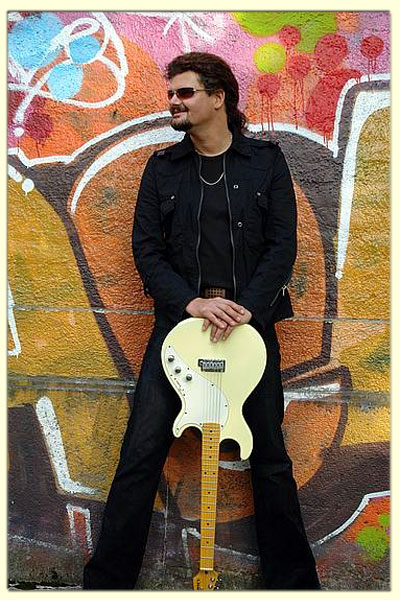
„Mir ist wichtig, dass mich die Musik berührt. Ich will spüren, dass der Künstler etwas zu sagen hat!“
Und der Gitarrist und Sänger Christian Schwarzbach teilt schon seit Jahren erfolgreich seine musikalischen Botschaften aus.
Der Saiten-Zauberer aus München ist einer von Deutschlands angefragtesten Studio- und Live-Musikern. Mit seinem einzigartigen Gitarrenspiel hat er sich bereits auf unzähligen Musik-Produktionen verewigt, mehr als 2000 Auftritte in der ganzen Welt absolviert. Sein Weg führte ihn nicht nur durch Deutschland, Östereich oder die Schweiz, nein, auch exotische Länder wie Russland und China wurden bespielt.
Die Gitarre hat der Multi-Kulti-Musiker im Alter von neun Jahren entdeckt, seit dem alle Musikrichtungen durchspielt. Dabei wurde die Bühne auch schon mit Top-Acts wie ZZ Top oder Jethro Tull geteilt.
Aufgrund seiner außergewöhnlichen Performance holten ihn Stars wie Toto-Sänger Bobby Kimball, Glen Hughes (Deep Purple) so wie Woodstock-Legende Fito de la Para (Canned Heat) auf die Bühne. Ob als Sideman für Dickie Peterson (Blue Cheer), oder 2010 als support für Gitarren-Genie Jeff Beck – Schwarzbach ist überall zu Hause, begeistert sein Publikum mit impulsanten Rock-Riffs und spektakulären, temporeichen Soli. Der Blues-Rock ist musikalische Hemat.
Doch seiner 1964er Fender Stratocaster entlockt er auch ganz andere Töne. Durch langjährige Mitwirkung bei „Soul Kitchen“ – einer der top Soul-Bands Deutschlands – sowie diversen Projekten mit der aus Los Angeles stammenden Sängerin Erin Perry, konnte sich Schwarzbach nicht nur in Deutschland, sondern auch europaweit einen Namen machen, sich musikalisch vielseitig präsentieren. So ganz nebenbei ist er Endorser der Gitarrenmarke Line 6 und Dozent am Münchner Gitarren Institut (MGI).
Zu seinen musikalischen Einflüssen zählen Musik-Größen wie Jeff Beck und Steve Lukather (Toto). Aber auch Blues Legenden wie Stevie Ray Vaughn und Robben Ford gaben – und geben – ihm Impulse.
Sein erstes Soloalbum „Anthology Part I“ wurde 2007 veröffentlicht. Die Musik-Fach-Zeitschrift „Gitarre & Bass“ schrieb dazu: „Eine wirklich fette, scharfe Lead-Gitarre mit den berühmten Eiern, spielt Christian Schwarzbach hier. Seine E-Gitarren Instumentals rocken, drücken, sägen – haben Emotion und Stil.“
Im Juli 2011 wurde sein aktuelles Solowerk „Antholygy Part II“ veröffentlicht, auf dem der Saitenhexer auch erstmals selbst zum Mikrofon greift. „Gitarre und Bass„ schreibt: „Was für ein Rocker! Gitarrist Christian Schwarzbach beherrscht sein Instrument, egal ob er shreddet oder eine Midtempo-Nummer mit Southern-Feel rüberkommen lässt. Der Tele-Spieler hat einen eigenen Stil, deftig, zupackend, irgendwie bluesig in jeder Note...„
Live wird Christian Schwarzbach von excellenten Musikern in seiner Gleichnamigen Band unterstützt.
Und der Gitarrist und Sänger Christian Schwarzbach teilt schon seit Jahren erfolgreich seine musikalischen Botschaften aus.
Der Saiten-Zauberer aus München ist einer von Deutschlands angefragtesten Studio- und Live-Musikern. Mit seinem einzigartigen Gitarrenspiel hat er sich bereits auf unzähligen Musik-Produktionen verewigt, mehr als 2000 Auftritte in der ganzen Welt absolviert. Sein Weg führte ihn nicht nur durch Deutschland, Östereich oder die Schweiz, nein, auch exotische Länder wie Russland und China wurden bespielt.
Die Gitarre hat der Multi-Kulti-Musiker im Alter von neun Jahren entdeckt, seit dem alle Musikrichtungen durchspielt. Dabei wurde die Bühne auch schon mit Top-Acts wie ZZ Top oder Jethro Tull geteilt.
Aufgrund seiner außergewöhnlichen Performance holten ihn Stars wie Toto-Sänger Bobby Kimball, Glen Hughes (Deep Purple) so wie Woodstock-Legende Fito de la Para (Canned Heat) auf die Bühne. Ob als Sideman für Dickie Peterson (Blue Cheer), oder 2010 als support für Gitarren-Genie Jeff Beck – Schwarzbach ist überall zu Hause, begeistert sein Publikum mit impulsanten Rock-Riffs und spektakulären, temporeichen Soli. Der Blues-Rock ist musikalische Hemat.
Doch seiner 1964er Fender Stratocaster entlockt er auch ganz andere Töne. Durch langjährige Mitwirkung bei „Soul Kitchen“ – einer der top Soul-Bands Deutschlands – sowie diversen Projekten mit der aus Los Angeles stammenden Sängerin Erin Perry, konnte sich Schwarzbach nicht nur in Deutschland, sondern auch europaweit einen Namen machen, sich musikalisch vielseitig präsentieren. So ganz nebenbei ist er Endorser der Gitarrenmarke Line 6 und Dozent am Münchner Gitarren Institut (MGI).
Zu seinen musikalischen Einflüssen zählen Musik-Größen wie Jeff Beck und Steve Lukather (Toto). Aber auch Blues Legenden wie Stevie Ray Vaughn und Robben Ford gaben – und geben – ihm Impulse.
Sein erstes Soloalbum „Anthology Part I“ wurde 2007 veröffentlicht. Die Musik-Fach-Zeitschrift „Gitarre & Bass“ schrieb dazu: „Eine wirklich fette, scharfe Lead-Gitarre mit den berühmten Eiern, spielt Christian Schwarzbach hier. Seine E-Gitarren Instumentals rocken, drücken, sägen – haben Emotion und Stil.“
Im Juli 2011 wurde sein aktuelles Solowerk „Antholygy Part II“ veröffentlicht, auf dem der Saitenhexer auch erstmals selbst zum Mikrofon greift. „Gitarre und Bass„ schreibt: „Was für ein Rocker! Gitarrist Christian Schwarzbach beherrscht sein Instrument, egal ob er shreddet oder eine Midtempo-Nummer mit Southern-Feel rüberkommen lässt. Der Tele-Spieler hat einen eigenen Stil, deftig, zupackend, irgendwie bluesig in jeder Note...„
Live wird Christian Schwarzbach von excellenten Musikern in seiner Gleichnamigen Band unterstützt.
Christian Schwarzbach & Band: Little Wing - Live 14.12.2012
R.I.P.
Jazz Gillum +29.03.1966
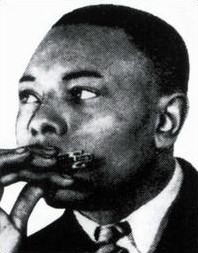
Wie B. B. King in Indianola geboren, brachte sich Gillum das Spielen auf der Blues Harp selbst bei. Nachdem er mit 7 Jahren von seinem Ziehvater weggelaufen war, verbrachte er die nächsten Jahre bei Verwandten in Charleston, Mississippi, wo er jobbte und an Straßenecken musizierte.
1923 ging er nach Chicago. Hier trat er häufig mit dem Gitarristen Big Bill Broonzy auf. 1934 machte Gillum seine ersten Aufnahmen.
In den 1930ern und 1940ern erschien er sowohl unter eigenem Namen wie auch als Begleitmusiker auf vielen von Lester Melrose produzierten Platten. Nach dem Ende von Bluebird Records war auch Gillums Karriere vorbei. 1961 machte er noch einmal Aufnahmen mit Memphis Slim.
Jazz Gillum starb 1966 durch einen Kopfschuss bei einer Streiterei.
http://de.wikipedia.org/wiki/Jazz_Gillum
William McKinley Gillum (September 11, 1904 – March 29, 1966),[1] known as Jazz Gillum, was an American blues harmonica player.
He was born in Indianola, Mississippi. After running away from home at the age of seven, Gillum spent the next few years in Charleston, Mississippi, working and playing for tips on local street corners. He moved to Chicago, Illinois in 1923, meeting up with the guitarist, Big Bill Broonzy.[1] The duo started working club dates around the city and, by 1934, Gillum started recording for both ARC and Bluebird Records.
He appeared on many of the highly popular "Bluebird beat" recordings produced by Lester Melrose in the 1930s and 1940s, under his own name and as a sideman.[1] Gillum was the first to record the blues classic "Key to the Highway" (featuring Broonzy on guitar) utilizing the now-standard melody and 8-bar blues arrangement. (The song had first been recorded a few months earlier by Charlie Segar, with a different melody and a 12-bar blues arrangement.) Gillum's version of the song was then covered by Broonzy a few months later, and has become the standard arrangement of this now-classic blues song. Gillum's records also resulted in some of the very earliest recordings of electric guitar in blues, when 16-year-old fledgling jazz guitarist George Barnes was featured on several songs on the 1938 Gillum session that produced "Reefer Headed Woman" and others.
Gillum joined the United States Army in 1942 and served until 1945.[2] Gillum recorded an early version of "Look on Yonder Wall" (1946) with Big Maceo on piano, which was later popularized by Elmore James.[3]
However, after the Bluebird record label folded in the late 1940s he made few further recordings. His last, slightly sad recordings were on a couple of 1961 albums with Memphis Slim and the singer-guitarist Arbee Stidham on Folkways Records.[3]
On 29 March 1966, during a street argument, he was shot in the head and was pronounced dead on arrival at Garfield Park Hospital in Chicago.[2] He is buried at Restvale Cemetery in Alsip, Illinois. [2]
Gillum's daughter, Ardella Williams, is active as a blues singer in Chicago.
He was born in Indianola, Mississippi. After running away from home at the age of seven, Gillum spent the next few years in Charleston, Mississippi, working and playing for tips on local street corners. He moved to Chicago, Illinois in 1923, meeting up with the guitarist, Big Bill Broonzy.[1] The duo started working club dates around the city and, by 1934, Gillum started recording for both ARC and Bluebird Records.
He appeared on many of the highly popular "Bluebird beat" recordings produced by Lester Melrose in the 1930s and 1940s, under his own name and as a sideman.[1] Gillum was the first to record the blues classic "Key to the Highway" (featuring Broonzy on guitar) utilizing the now-standard melody and 8-bar blues arrangement. (The song had first been recorded a few months earlier by Charlie Segar, with a different melody and a 12-bar blues arrangement.) Gillum's version of the song was then covered by Broonzy a few months later, and has become the standard arrangement of this now-classic blues song. Gillum's records also resulted in some of the very earliest recordings of electric guitar in blues, when 16-year-old fledgling jazz guitarist George Barnes was featured on several songs on the 1938 Gillum session that produced "Reefer Headed Woman" and others.
Gillum joined the United States Army in 1942 and served until 1945.[2] Gillum recorded an early version of "Look on Yonder Wall" (1946) with Big Maceo on piano, which was later popularized by Elmore James.[3]
However, after the Bluebird record label folded in the late 1940s he made few further recordings. His last, slightly sad recordings were on a couple of 1961 albums with Memphis Slim and the singer-guitarist Arbee Stidham on Folkways Records.[3]
On 29 March 1966, during a street argument, he was shot in the head and was pronounced dead on arrival at Garfield Park Hospital in Chicago.[2] He is buried at Restvale Cemetery in Alsip, Illinois. [2]
Gillum's daughter, Ardella Williams, is active as a blues singer in Chicago.