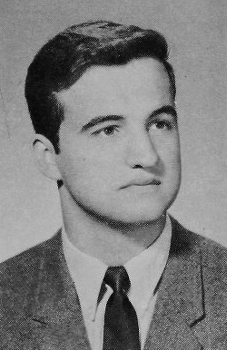
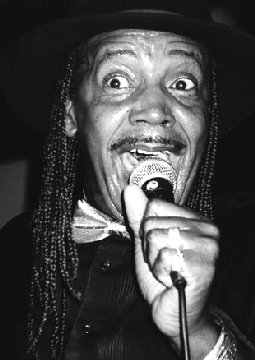
1893 Big Bill Broonzy*
1903 St. Louis Jimmy Oden*
1942 Larry "The Mole" Taylor*
1965 Hannes Kasehs*
1966 Scott Holt*
1967 Pat Boyack*
1979 Ximena Monzón*
1993 James "Son" Thomas+
2006 Johnny Jenkins+
Happy Birthday
Big Bill Broonzy *26.06.1893
:format(jpeg):mode_rgb():quality(90)/discogs-images/A-307270-1334384023.jpeg.jpg)
Big Bill Broonzy (geboren als Lee Conley Bradley; * 26. Juni 1893 oder 1898 in Scott County, Mississippi; † 15. August 1958 in Chicago, Illinois) war ein US-amerikanischer Blues-Musiker und -Komponist.
Bill Broonzy, geboren als Lee Conley Bradley, war eines von 17 Kindern seiner Eltern Frank und Mittie Bradley.[1] Den größten Teil seiner Kindheit soll er in Arkansas verbracht haben, wo er bereits durch seinen Onkel Jerry Belcher das Fiedelspiel erlernte und in bescheidenem Maße auch auftrat. Seine Wehrpflicht leistete er während des Ersten Weltkriegs in Europa ab. Anschließend verdingte er sich als Feldarbeiter. 1920 ging Big Bill Broonzy nach Chicago, wo ihm Papa Charlie Jackson das Gitarrespielen beibrachte. 1927 machte er erste Aufnahmen für Paramount. Unter den Liedern, bei denen er sich selbst begleitete, war auch der Song „Big Billy Blues“, von dem künftig sein Künstlername abgeleitet wurde. Broonzy konnte von seiner Musik zunächst nicht leben und ging bis in die 1950er Jahre noch anderen Berufen nach.
Nach 1930 nahm er mit Georgia Tom (eigentlich: Thomas Andrew Dorsey) am Klavier und Frank Basswell unter dem Gruppennamen „Famous Hokum Boys“ verschiedene Platten auf. Um 1936 begann er, mit einer kleinen Band aufzutreten, mit Schlagzeug und Bass, gelegentlich ergänzt um Mundharmonika, Piano oder Blasinstrumente. Die Aufnahmen aus dieser Zeit firmieren unter dem Namen Big Bill and his Chicago Five. In der Fachliteratur (z. B. bei Dicaire, siehe Bibliografie) gibt es Hinweise, dass Broonzy möglicherweise das Powertrio in die populäre Musik eingeführt hat – ein Konzept, das später Musiker und Bands wie Jimi Hendrix, ZZ Top und Cream in der Rockmusik erfolgreich machten.
In den 1930ern war Broonzy u. a. mit Memphis Minnie unterwegs. Nach dem Tod von Robert Johnson wurde Broonzy an dessen Stelle für die New Yorker Show From Spiritual To Swing engagiert und wurde auch vom weißen Publikum begeistert aufgenommen. In den 1950ern war er mehrfach erfolgreich in Europa auf Tour. Er machte Aufnahmen u. a. mit Pete Seeger, Sonny Terry, Brownie McGhee und Leadbelly und wurde 1953 letztlich Berufsmusiker.
1957 erkrankte Big Bill Broonzy an Kehlkopfkrebs und starb daran ein Jahr später. Er wurde in Chicago beigesetzt.
Big Bill Broonzy hatte einen nicht unwesentlichen Einfluss auf Bluesgrößen wie Muddy Waters und Memphis Slim. Er war ein ausgezeichneter Gitarrespieler und hat über 350 Stücke komponiert. 1980 wurde er in die Hall of Fame der Blues Foundation aufgenommen, ebenso 2010 sein Song Key to the Highway und seine Autobiographie (gemeinsam mit Yannick Bruynoghe) Big Bill Blues 1990.
http://de.wikipedia.org/wiki/Big_Bill_Broonzy
Big Bill Broonzy (June 26, 1893 – August 14 or 15, 1958) was a prolific American blues singer, songwriter and guitarist. His career began in the 1920s when he played country blues to mostly African-American audiences. Through the 1930s and 1940s he successfully navigated a transition in style to a more urban blues sound popular with working-class African-American audiences. In the 1950s a return to his traditional folk-blues roots made him one of the leading figures of the emerging American folk music revival and an international star. His long and varied career marks him as one of the key figures in the development of blues music in the 20th century.
Broonzy copyrighted more than 300 songs during his lifetime, including both adaptations of traditional folk songs and original blues songs. As a blues composer, he was unique in that his compositions reflected the many vantage points of his rural-to-urban experiences.[1]
Life and career
Early years
Born Lee Conley Bradley,[2] "Big Bill" was one of Frank Broonzy (Bradley) and Mittie Belcher's 17 children. His birth site and date are disputed. While he claimed birth in Scott, Mississippi, an entire body of emerging research compiled by blues historian Robert Reisman suggests that Broonzy was actually born in Jefferson County, Arkansas. Broonzy claimed he was born in 1893 and many sources report that year, but after his death, family records suggested that the year was actually 1903.[3] Soon after his birth the family moved to the Pine Bluff, Arkansas area, where Bill spent his youth. He began playing music at an early age. At the age of 10 he made himself a fiddle from a cigar box and learned how to play spirituals and folk songs from his uncle, Jerry Belcher. He and a friend named Louis Carter, who played a homemade guitar, began performing at social and church functions.[4] These early performances included playing at "two-stages": picnics where whites and blacks danced at the same event, but with different stages for blacks and whites.[5]
On the understanding that he was born in 1898 rather than earlier or later, sources suggest that in 1915, 17-year-old Broonzy was married and working as a sharecropper. He had decided to give up the fiddle and become a preacher. There is a story that he was offered $50 and a new violin if he would play four days at a local venue. Before he could respond to the offer, his wife took the money and spent it, so he had to play. In 1916 his crop and stock were wiped out by drought. Broonzy went to work locally until he was drafted into the Army in 1917.[6] Broonzy served two years in Europe during the first world war. Then after his discharge from the Army in 1919, Broonzy returned to the Pine Bluff, Arkansas area, where he is reported to have been called a racial epithet and told by a white man he knew before the war that he needed to "hurry up and get his soldier uniform off and put on some overalls." He immediately left Pine Bluff and moved to the Little Rock area but a year later in 1920 moved north to Chicago in search of opportunity.[7]
1920s
After arriving in Chicago, Broonzy made the switch from fiddle to guitar. He learned guitar from minstrel and medicine show veteran Papa Charlie Jackson, who began recording for Paramount Records in 1924.[8] Through the 1920s Broonzy worked a string of odd jobs, including Pullman porter, cook, foundry worker and custodian, to supplement his income, but his main interest was music. He played regularly at rent parties and social gatherings, steadily improving his guitar playing. During this time he wrote one of his signature tunes, a solo guitar piece called "Saturday Night Rub".[9]
Thanks to his association with Jackson, Broonzy was able to get an audition with Paramount executive J. Mayo Williams. His initial test recordings, made with his friend John Thomas on vocals, were rejected, but Broonzy persisted, and his second try, a few months later, was more successful. His first record, "Big Bill's Blues" backed with "House Rent Stomp", credited to "Big Bill and Thomps" (Paramount 12656), was released in 1927. Although the recording was not well received, Paramount retained their new talent and the next few years saw more releases by "Big Bill and Thomps". The records continued to sell poorly. Reviewers considered his style immature and derivative.[10]
1930s
In 1930, Paramount for the first time used Broonzy's full name on a recording, "Station Blues" – albeit misspelled as "Big Bill Broomsley". Record sales continued to be poor, and Broonzy was working at a grocery store. Broonzy was picked up by Lester Melrose, who produced acts for various labels including Champion and Gennett Records. He recorded several sides which were released in the spring of 1931 under the name "Big Bill Johnson".[11] In March 1932 he traveled to New York City and began recording for the American Record Corporation on their line of less expensive labels (Melotone, Perfect Records, et al.).[9] These recordings sold better and Broonzy was becoming better known. Back in Chicago he was working regularly in South Side clubs, and even toured with Memphis Minnie.[12]
In 1934 Broonzy moved to Bluebird Records and began recording with pianist Bob "Black Bob" Call. His fortunes soon improved. With Call his music was evolving to a stronger R&B sound, and his singing sounded more assured and personal. In 1937, he began playing with pianist Joshua Altheimer, recording and performing using a small instrumental group, including "traps" (drums) and double bass as well as one or more melody instruments (horns and/or harmonica). In March 1938 he began recording for Vocalion Records.[13]
Broonzy's reputation grew and in 1938 he was asked to fill in for the recently deceased Robert Johnson at the John H. Hammond-produced From Spirituals to Swing concert at Carnegie Hall. He also appeared in the 1939 concert at the same venue.[14] His success led him in this same year to a small role in Swingin' the Dream, Gilbert Seldes's jazz adaptation of Shakespeare's Midsummer Night's Dream, set in 1890 New Orleans and featuring, among others, Louis Armstrong as Bottom and Maxine Sullivan as Titania, with the Benny Goodman sextet.
Broonzy's own recorded output through the 1930s only partially reflects his importance to the Chicago blues scene. His half-brother, Washboard Sam, and close friends, Jazz Gillum, and Tampa Red, also recorded for Bluebird. Broonzy was credited as composer on many of their most popular recordings of that time. He reportedly played guitar on most of Washboard Sam's tracks. Due to his exclusive arrangements with his own record label, Broonzy was always careful to have his name only appear on these artists' records as "composer".[13]
1940s
Broonzy expanded his work during this period as he honed his song writing skills which showed a knack for appealing to his more sophisticated city audience as well as people that shared his country roots. His work in this period shows he performed across a wider musical spectrum than almost any other bluesman before or since including ragtime, hokum blues, country blues, city blues, jazz tinged songs, folk songs and spirituals. After World War II, Broonzy recorded songs that were the bridge that allowed many younger musicians to cross over to the future of the blues: the electric blues of post war Chicago. His 1945 recordings of "Where the Blues Began" with Big Maceo on piano and Buster Bennett on sax, or "Martha Blues" with Memphis Slim on piano, clearly show the way forward. One of his best-known songs, "Key to the Highway", appeared at this time. When the second American Federation of Musicians strike ended in 1948, Broonzy was picked up by the Mercury label[15]
In 1949, Broonzy became part of a touring folk music revue formed by Win Stracke called I Come for to Sing, which also included Studs Terkel and Lawrence Lane. Terkel called him the key figure in this group. The revue had some success thanks to the emerging folk revival movement. When the revue played Iowa State University in Ames, Iowa, Broonzy met a local couple, Prof. Leonard and Lillian Feinberg, who would find him a custodial job at ISU when a doctor ordered Bill to leave the road for his health later in 1949. He remained in Ames until 1951, then resumed touring. [16]
1950s
After returning to the road, the exposure from I Come For to Sing made it possible for Broonzy to tour Europe in 1951. Here Bill was greeted with standing ovations and critical praise wherever he played. The tour marked a turning point in his fortunes, and when he returned to the United States he was a featured act with many prominent folk artists such as Pete Seeger, Sonny Terry and Brownie McGhee. From 1953 on his financial position became more secure and he was able to live quite well on his music earnings. Broonzy returned to his solo folk-blues roots, and travelled and recorded extensively.[15] Broonzy's numerous performances during the 1950s in British folk and jazz clubs were a significant influence on British audiences' understanding of the blues,[17] and significantly bolstered the nascent British folk revival and early blues scene. Many British musicians on the folk scene, such as Bert Jansch, cited him as an important influence.[18]
While in the Netherlands, Broonzy met and became romanically involved with a Dutch girl, Pim van Isveldt. Together they had a child named Michael who still lives in Amsterdam.[19][20]
In 1953, Dr. Vera (King) Morkovin and Studs Terkel took Broonzy to Circle Pines Center, a cooperative year-round camp in Hastings, Michigan, where he was employed as the summer camp cook. He worked there in the summer from 1953 to 1956. On July 4, 1954, Pete Seeger travelled to Circle Pines and gave a concert with Bill on the farmhouse lawn, which was recorded by Seeger for the new fine arts radio station in Chicago, WFMT-FM.[21]
In 1955, with the assistance of Belgian writer Yannick Bruynoghe, Broonzy published his autobiography, entitled Big Bill Blues.[14] He toured worldwide to Africa, South America, the Pacific region and across Europe into early 1956. In 1957 Broonzy was one of the founding faculty members of the Old Town School of Folk Music. At the school's opening night on December 1, he taught a class "The Glory of Love".[22]
Illness and death
By 1958 Broonzy was suffering from the effects of throat cancer. He died on August 14 or 15, 1958 (sources vary on the precise date), and is buried in Lincoln Cemetery, Blue Island, Illinois.[23][24]
Style and influence
Broonzy's own influences included the folk music, spirituals, work songs, ragtime music, hokum, and country blues he heard growing up, and the styles of his contemporaries, including Jimmie Rodgers, Blind Blake, Son House, and Blind Lemon Jefferson. Broonzy combined all these influences into his own style of the blues that foreshadowed the post-war Chicago blues sound, later refined and popularized by artists such as Muddy Waters and Willie Dixon.[14]
Although he had been a pioneer of the Chicago blues style and had employed electric instruments as early as 1942, his new, white audiences wanted to hear him playing his earliest songs accompanied only by his own acoustic guitar, since this was considered to be more "authentic".
A considerable part of his early ARC/CBS recordings have been reissued in anthology collections by CBS-Sony, and other earlier recordings have been collected on blues reissue labels, as have his later European and Chicago recordings of the 1950s. The Smithsonian's Folkways Records has also released several albums featuring Big Bill Broonzy.
In 1980, he was inducted into the first class of the Blues Hall of Fame along with 20 other of the world's greatest blues legends. In 2007, he was inducted into the first class of the Gennett Records Walk of Fame along with 11 other musical greats including Louis Armstrong, Jelly Roll Morton, Gene Autry, Lawrence Welk, and others.
Broonzy as an acoustic guitar player inspired Muddy Waters, Memphis Slim, Ray Davies, John Renbourn, Rory Gallagher,[25] Ben Taylor,[26] and Steve Howe.[27]
In in the September 2007 issue of Q Magazine, Ronnie Wood of the Rolling Stones cited Broonzy's track "Guitar Shuffle" as his favorite guitar music. Wood remarked, "It was one of the first tracks I learnt to play, but even to this day I can't play it exactly right."
Eric Clapton has cited Bill Broonzy as a major inspiration, commenting that Broonzy "became like a role model for me, in terms of how to play the acoustic guitar."[28]
Broonzy's influence on roots rockers the Blasters is apparent. In 2014, the Blasters' founders Dave Alvin and Phil Alvin, as a duo, released the album Common Ground: Dave Alvin & Phil Alvin Play and Sing the Songs of Big Bill Broonzy. Dave Alvin commented, "We're brothers, we argue sometimes, but one thing we never argue about is Big Bill Broonzy."[29]
During the benediction at the 2009 inauguration ceremony of President Barack Obama, the civil rights leader Rev. Dr. Joseph Lowery paraphrased Broonzy's song "Black, Brown and White Blues".
http://en.wikipedia.org/wiki/Big_Bill_BroonzyBroonzy copyrighted more than 300 songs during his lifetime, including both adaptations of traditional folk songs and original blues songs. As a blues composer, he was unique in that his compositions reflected the many vantage points of his rural-to-urban experiences.[1]
Life and career
Early years
Born Lee Conley Bradley,[2] "Big Bill" was one of Frank Broonzy (Bradley) and Mittie Belcher's 17 children. His birth site and date are disputed. While he claimed birth in Scott, Mississippi, an entire body of emerging research compiled by blues historian Robert Reisman suggests that Broonzy was actually born in Jefferson County, Arkansas. Broonzy claimed he was born in 1893 and many sources report that year, but after his death, family records suggested that the year was actually 1903.[3] Soon after his birth the family moved to the Pine Bluff, Arkansas area, where Bill spent his youth. He began playing music at an early age. At the age of 10 he made himself a fiddle from a cigar box and learned how to play spirituals and folk songs from his uncle, Jerry Belcher. He and a friend named Louis Carter, who played a homemade guitar, began performing at social and church functions.[4] These early performances included playing at "two-stages": picnics where whites and blacks danced at the same event, but with different stages for blacks and whites.[5]
On the understanding that he was born in 1898 rather than earlier or later, sources suggest that in 1915, 17-year-old Broonzy was married and working as a sharecropper. He had decided to give up the fiddle and become a preacher. There is a story that he was offered $50 and a new violin if he would play four days at a local venue. Before he could respond to the offer, his wife took the money and spent it, so he had to play. In 1916 his crop and stock were wiped out by drought. Broonzy went to work locally until he was drafted into the Army in 1917.[6] Broonzy served two years in Europe during the first world war. Then after his discharge from the Army in 1919, Broonzy returned to the Pine Bluff, Arkansas area, where he is reported to have been called a racial epithet and told by a white man he knew before the war that he needed to "hurry up and get his soldier uniform off and put on some overalls." He immediately left Pine Bluff and moved to the Little Rock area but a year later in 1920 moved north to Chicago in search of opportunity.[7]
1920s
After arriving in Chicago, Broonzy made the switch from fiddle to guitar. He learned guitar from minstrel and medicine show veteran Papa Charlie Jackson, who began recording for Paramount Records in 1924.[8] Through the 1920s Broonzy worked a string of odd jobs, including Pullman porter, cook, foundry worker and custodian, to supplement his income, but his main interest was music. He played regularly at rent parties and social gatherings, steadily improving his guitar playing. During this time he wrote one of his signature tunes, a solo guitar piece called "Saturday Night Rub".[9]
Thanks to his association with Jackson, Broonzy was able to get an audition with Paramount executive J. Mayo Williams. His initial test recordings, made with his friend John Thomas on vocals, were rejected, but Broonzy persisted, and his second try, a few months later, was more successful. His first record, "Big Bill's Blues" backed with "House Rent Stomp", credited to "Big Bill and Thomps" (Paramount 12656), was released in 1927. Although the recording was not well received, Paramount retained their new talent and the next few years saw more releases by "Big Bill and Thomps". The records continued to sell poorly. Reviewers considered his style immature and derivative.[10]
1930s
In 1930, Paramount for the first time used Broonzy's full name on a recording, "Station Blues" – albeit misspelled as "Big Bill Broomsley". Record sales continued to be poor, and Broonzy was working at a grocery store. Broonzy was picked up by Lester Melrose, who produced acts for various labels including Champion and Gennett Records. He recorded several sides which were released in the spring of 1931 under the name "Big Bill Johnson".[11] In March 1932 he traveled to New York City and began recording for the American Record Corporation on their line of less expensive labels (Melotone, Perfect Records, et al.).[9] These recordings sold better and Broonzy was becoming better known. Back in Chicago he was working regularly in South Side clubs, and even toured with Memphis Minnie.[12]
In 1934 Broonzy moved to Bluebird Records and began recording with pianist Bob "Black Bob" Call. His fortunes soon improved. With Call his music was evolving to a stronger R&B sound, and his singing sounded more assured and personal. In 1937, he began playing with pianist Joshua Altheimer, recording and performing using a small instrumental group, including "traps" (drums) and double bass as well as one or more melody instruments (horns and/or harmonica). In March 1938 he began recording for Vocalion Records.[13]
Broonzy's reputation grew and in 1938 he was asked to fill in for the recently deceased Robert Johnson at the John H. Hammond-produced From Spirituals to Swing concert at Carnegie Hall. He also appeared in the 1939 concert at the same venue.[14] His success led him in this same year to a small role in Swingin' the Dream, Gilbert Seldes's jazz adaptation of Shakespeare's Midsummer Night's Dream, set in 1890 New Orleans and featuring, among others, Louis Armstrong as Bottom and Maxine Sullivan as Titania, with the Benny Goodman sextet.
Broonzy's own recorded output through the 1930s only partially reflects his importance to the Chicago blues scene. His half-brother, Washboard Sam, and close friends, Jazz Gillum, and Tampa Red, also recorded for Bluebird. Broonzy was credited as composer on many of their most popular recordings of that time. He reportedly played guitar on most of Washboard Sam's tracks. Due to his exclusive arrangements with his own record label, Broonzy was always careful to have his name only appear on these artists' records as "composer".[13]
1940s
Broonzy expanded his work during this period as he honed his song writing skills which showed a knack for appealing to his more sophisticated city audience as well as people that shared his country roots. His work in this period shows he performed across a wider musical spectrum than almost any other bluesman before or since including ragtime, hokum blues, country blues, city blues, jazz tinged songs, folk songs and spirituals. After World War II, Broonzy recorded songs that were the bridge that allowed many younger musicians to cross over to the future of the blues: the electric blues of post war Chicago. His 1945 recordings of "Where the Blues Began" with Big Maceo on piano and Buster Bennett on sax, or "Martha Blues" with Memphis Slim on piano, clearly show the way forward. One of his best-known songs, "Key to the Highway", appeared at this time. When the second American Federation of Musicians strike ended in 1948, Broonzy was picked up by the Mercury label[15]
In 1949, Broonzy became part of a touring folk music revue formed by Win Stracke called I Come for to Sing, which also included Studs Terkel and Lawrence Lane. Terkel called him the key figure in this group. The revue had some success thanks to the emerging folk revival movement. When the revue played Iowa State University in Ames, Iowa, Broonzy met a local couple, Prof. Leonard and Lillian Feinberg, who would find him a custodial job at ISU when a doctor ordered Bill to leave the road for his health later in 1949. He remained in Ames until 1951, then resumed touring. [16]
1950s
After returning to the road, the exposure from I Come For to Sing made it possible for Broonzy to tour Europe in 1951. Here Bill was greeted with standing ovations and critical praise wherever he played. The tour marked a turning point in his fortunes, and when he returned to the United States he was a featured act with many prominent folk artists such as Pete Seeger, Sonny Terry and Brownie McGhee. From 1953 on his financial position became more secure and he was able to live quite well on his music earnings. Broonzy returned to his solo folk-blues roots, and travelled and recorded extensively.[15] Broonzy's numerous performances during the 1950s in British folk and jazz clubs were a significant influence on British audiences' understanding of the blues,[17] and significantly bolstered the nascent British folk revival and early blues scene. Many British musicians on the folk scene, such as Bert Jansch, cited him as an important influence.[18]
While in the Netherlands, Broonzy met and became romanically involved with a Dutch girl, Pim van Isveldt. Together they had a child named Michael who still lives in Amsterdam.[19][20]
In 1953, Dr. Vera (King) Morkovin and Studs Terkel took Broonzy to Circle Pines Center, a cooperative year-round camp in Hastings, Michigan, where he was employed as the summer camp cook. He worked there in the summer from 1953 to 1956. On July 4, 1954, Pete Seeger travelled to Circle Pines and gave a concert with Bill on the farmhouse lawn, which was recorded by Seeger for the new fine arts radio station in Chicago, WFMT-FM.[21]
In 1955, with the assistance of Belgian writer Yannick Bruynoghe, Broonzy published his autobiography, entitled Big Bill Blues.[14] He toured worldwide to Africa, South America, the Pacific region and across Europe into early 1956. In 1957 Broonzy was one of the founding faculty members of the Old Town School of Folk Music. At the school's opening night on December 1, he taught a class "The Glory of Love".[22]
Illness and death
By 1958 Broonzy was suffering from the effects of throat cancer. He died on August 14 or 15, 1958 (sources vary on the precise date), and is buried in Lincoln Cemetery, Blue Island, Illinois.[23][24]
Style and influence
Broonzy's own influences included the folk music, spirituals, work songs, ragtime music, hokum, and country blues he heard growing up, and the styles of his contemporaries, including Jimmie Rodgers, Blind Blake, Son House, and Blind Lemon Jefferson. Broonzy combined all these influences into his own style of the blues that foreshadowed the post-war Chicago blues sound, later refined and popularized by artists such as Muddy Waters and Willie Dixon.[14]
Although he had been a pioneer of the Chicago blues style and had employed electric instruments as early as 1942, his new, white audiences wanted to hear him playing his earliest songs accompanied only by his own acoustic guitar, since this was considered to be more "authentic".
A considerable part of his early ARC/CBS recordings have been reissued in anthology collections by CBS-Sony, and other earlier recordings have been collected on blues reissue labels, as have his later European and Chicago recordings of the 1950s. The Smithsonian's Folkways Records has also released several albums featuring Big Bill Broonzy.
In 1980, he was inducted into the first class of the Blues Hall of Fame along with 20 other of the world's greatest blues legends. In 2007, he was inducted into the first class of the Gennett Records Walk of Fame along with 11 other musical greats including Louis Armstrong, Jelly Roll Morton, Gene Autry, Lawrence Welk, and others.
Broonzy as an acoustic guitar player inspired Muddy Waters, Memphis Slim, Ray Davies, John Renbourn, Rory Gallagher,[25] Ben Taylor,[26] and Steve Howe.[27]
In in the September 2007 issue of Q Magazine, Ronnie Wood of the Rolling Stones cited Broonzy's track "Guitar Shuffle" as his favorite guitar music. Wood remarked, "It was one of the first tracks I learnt to play, but even to this day I can't play it exactly right."
Eric Clapton has cited Bill Broonzy as a major inspiration, commenting that Broonzy "became like a role model for me, in terms of how to play the acoustic guitar."[28]
Broonzy's influence on roots rockers the Blasters is apparent. In 2014, the Blasters' founders Dave Alvin and Phil Alvin, as a duo, released the album Common Ground: Dave Alvin & Phil Alvin Play and Sing the Songs of Big Bill Broonzy. Dave Alvin commented, "We're brothers, we argue sometimes, but one thing we never argue about is Big Bill Broonzy."[29]
During the benediction at the 2009 inauguration ceremony of President Barack Obama, the civil rights leader Rev. Dr. Joseph Lowery paraphrased Broonzy's song "Black, Brown and White Blues".
Larry "The Mole" Taylor *26.06.1942
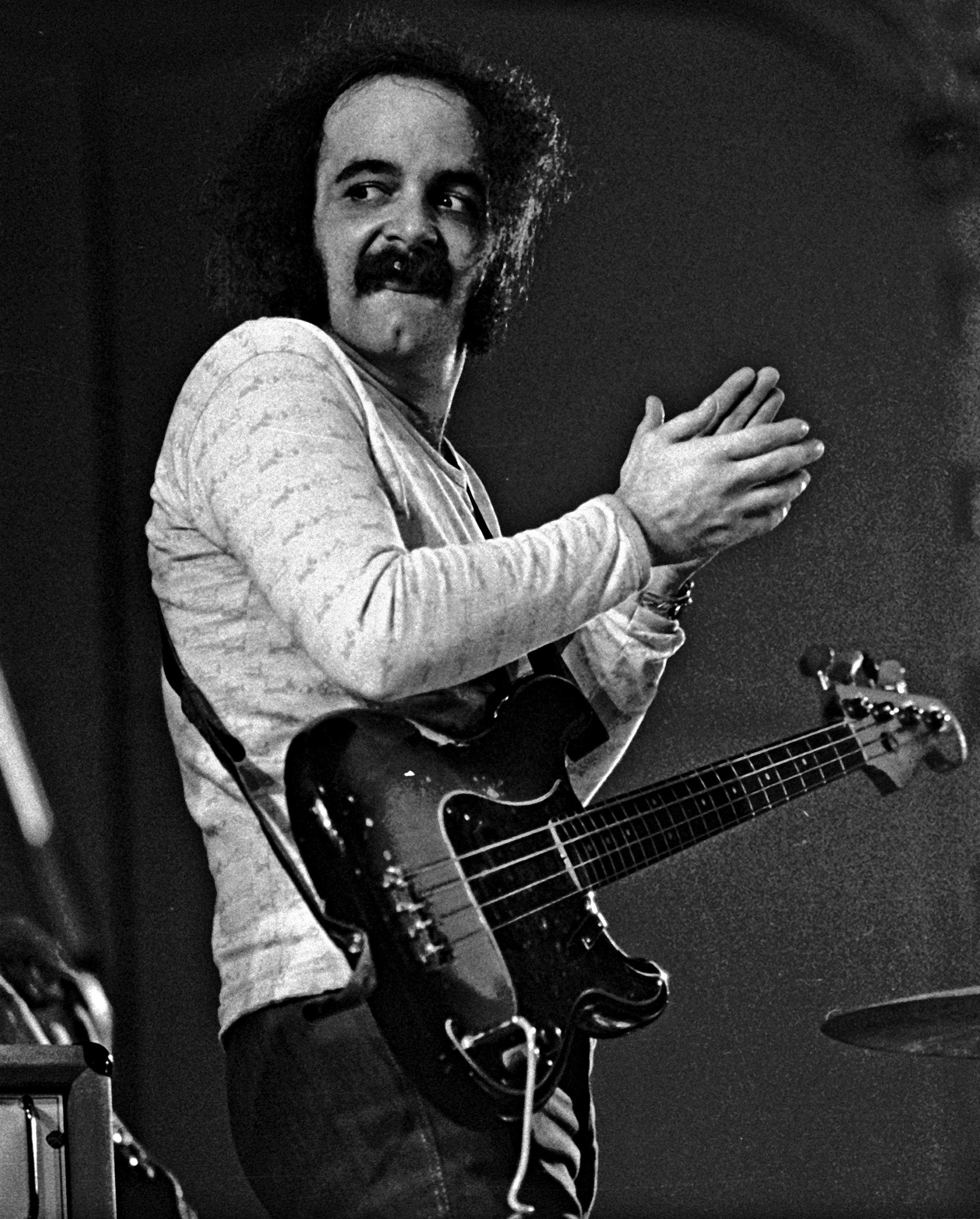 Larry "The Mole" Taylor (* 6. Juni 1942 in Brooklyn, New York City als Samuel Taylor) ist ein US-amerikanischer Bass-Gitarrist und das letzte lebende Gründungsmitglied von Canned Heat.
Taylor begann seine Karriere 1958 als er kurzzeitig Mitglied der Band Moon Dogs von P. J. Proby war. Die Band wurde kurz darauf aufgelöst. Mit 18 begleitete er Jerry Lee Lewis auf seinen Tourneen, als dieser sich gerade von seinem Karrieretief erholte. Kurzzeitig spielte er auch für Chuck Berry.
Erste Erfolge
Erste Erfolge konnte er mit The Monkees feiern. Nach seinen Tourneen mit Lewis und Berry wurde er als unabhängiger Bassist von den Monkees engagiert und war u. a. an den Hits Last Train To Clarksville und (Theme From) The Monkees mitwirkte. In seiner Zeit bei The Monkees war er an den ersten beiden Alben beteiligt.
Canned Heat
Im März 1967 stieß er zu der Band Canned Heat und zählt zu den Gründungsmitgliedern, obgleich die Band offiziell schon 1965 (nach anderen Angaben 1966) gegründet wurde. Mit Canned Heat feierte er seine größten Erfolge. So trat er am 17. Juni 1967 beim Monterey Pop Festival und im August 1969 beim Woodstock-Festival auf. Bei einem Auftritt im Juli 1969 im Fillmore East kam es zwischen Taylor und Henry Vestine zu einem Streit, so dass dieser die Band verließ. Auch Taylor verließ 1970 die Band. 1988 kehrte er zurück (LP "Reheated") und spielte bis 1999 immer wieder live und im Studio für Canned Heat.
Weitere Karriere
Nachdem Taylor 1970 Canned Heat verließ, schloss er sich im Mai den Bluesbreakers von John Mayall an, wo er bis 1973 blieb. Bis 1994 verweilte er selten länger bei einem Musiker oder einer Band, spielte zumeist als Gastmusiker und gründete das Larry Joe Taylor's Annual Texas Music Festival mit (benannt nach dem Countrysänger Larry Joe Taylor). Weitere Musiker, mit denen Taylor zusammenarbeitete, waren Tom Waits, Kim Wilson, Albert King und Little Milton. Derzeit spielt Larry Taylor den Upright-Bass bei den "Hollywood Blue Flames".
Triva
Sein Bruder Mel Taylor war bis zu seinem Tod Schlagzeuger der Band The Ventures. Nach seinem Tod wurde er durch seinen Sohn Leon ersetzt.
http://de.wikipedia.org/wiki/Larry_Taylor
http://popcultureaddict.com/interviews/larrytaylor/
Samuel Lawrence "Larry" Taylor (born June 26, 1942) is an American bass guitarist, best known for his work as a member of Canned Heat from 1967. Before joining Canned Heat he had been a session bassist for The Monkees and Jerry Lee Lewis.[1] He is the younger brother of Mel Taylor, long-time drummer for The Ventures.
Life and career
Taylor was born in New York, New York. His mother was Jewish and his father was a "WASP" from Tennessee.[2] Taylor played bass guitar in The Gamblers, one of the first rock groups to play instrumental surf music. Its personnel also included Elliot Ingber, a future member of Frank Zappa's Mothers of Invention, Fraternity of Man and Captain Beefheart's The Magic Band; Bruce Johnston, half of the Bruce and Terry duo with Terry Melcher from 1962–66 and longtime "sixth" member of The Beach Boys, for a time brother Mel Taylor, and guitarist-songwriter-bandleader Derry Weaver, who would record and perform in several capacities during the early 1960s. The Gamblers had a local hit in the Los Angeles area with "Moon Dawg" and Taylor played on the recording.
Taylor played with Canned Heat from 1967 to 1970, and appeared with them at various festivals including the Monterey International Pop Festival and Woodstock .[3]
His band nickname was "The Mole." In addition to playing bass, he also played lead guitar on occasion. An example can be heard on the track "Down In the Gutter, But Free," on the album Hallelujah. In 1969, due to a dispute with Taylor, Henry Vestine left the band. Guitarist Harvey Mandel filled the void as the band's lead guitarist. In 1970, when John Mayall moved to Los Angeles, Taylor and Mandel quit Canned Heat to join him in the Bluesbreakers. After the Bluesbreakers tours, Taylor played briefly with the Sugarcane Harris Band (later called Pure Food and Drug Act).
In 1974, Taylor became part of The Hollywood Fats Band led by Mike "Hollywood Fats" Mann. The two of them joined Canned Heat for a King Biscuit Flower Hour concert in 1979. Taylor recorded Reheated in 1988, again with Canned Heat. He toured and recorded with his former band a few more times until 1999. In 2007, Taylor and Harvey Mandel reunited with Fito de la Parra and the rest of the current Canned Heat line-up to perform certain shows. Taylor, Mandel and de la Parra were all in the line-up that played Woodstock. The three members of Canned Heats Woodstock line-up have toured extensively from 2009 to 2013.
Recently, Taylor has become a leading exponent and practitioner of the acoustic upright bass in the contemporary blues scene. He is quite prominently seen with his upright bass in the live blues film, Lightning in a Bottle. He will also be featured in a concert DVD to be released in winter 2013, from the album Time Brings About A Change by Floyd Dixon. This concert features three elder piano players — Dixon, Pinetop Perkins and Henry Gray — and was filmed at the Rhythm Room in Phoenix, Arizona on June 1 and 2, 2006.
Taylor has played on numerous Tom Waits albums and is the bass player in his touring band.[4]
In 2014, Taylor was nominated for a Blues Music Award in the 'Best Instrumentalist – Bass' category.
Life and career
Taylor was born in New York, New York. His mother was Jewish and his father was a "WASP" from Tennessee.[2] Taylor played bass guitar in The Gamblers, one of the first rock groups to play instrumental surf music. Its personnel also included Elliot Ingber, a future member of Frank Zappa's Mothers of Invention, Fraternity of Man and Captain Beefheart's The Magic Band; Bruce Johnston, half of the Bruce and Terry duo with Terry Melcher from 1962–66 and longtime "sixth" member of The Beach Boys, for a time brother Mel Taylor, and guitarist-songwriter-bandleader Derry Weaver, who would record and perform in several capacities during the early 1960s. The Gamblers had a local hit in the Los Angeles area with "Moon Dawg" and Taylor played on the recording.
Taylor played with Canned Heat from 1967 to 1970, and appeared with them at various festivals including the Monterey International Pop Festival and Woodstock .[3]
His band nickname was "The Mole." In addition to playing bass, he also played lead guitar on occasion. An example can be heard on the track "Down In the Gutter, But Free," on the album Hallelujah. In 1969, due to a dispute with Taylor, Henry Vestine left the band. Guitarist Harvey Mandel filled the void as the band's lead guitarist. In 1970, when John Mayall moved to Los Angeles, Taylor and Mandel quit Canned Heat to join him in the Bluesbreakers. After the Bluesbreakers tours, Taylor played briefly with the Sugarcane Harris Band (later called Pure Food and Drug Act).
In 1974, Taylor became part of The Hollywood Fats Band led by Mike "Hollywood Fats" Mann. The two of them joined Canned Heat for a King Biscuit Flower Hour concert in 1979. Taylor recorded Reheated in 1988, again with Canned Heat. He toured and recorded with his former band a few more times until 1999. In 2007, Taylor and Harvey Mandel reunited with Fito de la Parra and the rest of the current Canned Heat line-up to perform certain shows. Taylor, Mandel and de la Parra were all in the line-up that played Woodstock. The three members of Canned Heats Woodstock line-up have toured extensively from 2009 to 2013.
Recently, Taylor has become a leading exponent and practitioner of the acoustic upright bass in the contemporary blues scene. He is quite prominently seen with his upright bass in the live blues film, Lightning in a Bottle. He will also be featured in a concert DVD to be released in winter 2013, from the album Time Brings About A Change by Floyd Dixon. This concert features three elder piano players — Dixon, Pinetop Perkins and Henry Gray — and was filmed at the Rhythm Room in Phoenix, Arizona on June 1 and 2, 2006.
Taylor has played on numerous Tom Waits albums and is the bass player in his touring band.[4]
In 2014, Taylor was nominated for a Blues Music Award in the 'Best Instrumentalist – Bass' category.
http://popcultureaddict.com/interviews/larrytaylor/
Pat Boyack *26.06.1967

Pat Boyack (born June 26, 1967, Price, Utah, United States)[2] is an American electric blues guitarist and songwriter. Boyack performs modern electric blues and blues rock. He has released four albums since 1994, for both the Bullseye Blues and Doc Blues record labels.
Boyack was born in Price, but grew up in Helper, Utah.[2] At the age of fifteen he had his first guitar, and listened to a college friend's Stevie Ray Vaughan album.[1] Inspired by contemporary Texas blues, Boyack moved to Dallas, Texas, in 1991, and played in a number of bar bands, including Rocket 88s. In 1993, Boyack formed the Prowlers with John Garza (bass) and Doug Swancy (drums). The Prowlers added Jimmy Morello (singer/harmonica) and secured a recording contract with Bullseye Blues Records (part of Rounder Records).[1][2]
Pat Boyack & the Prowlers debut album Breakin' In (1994), was followed by On the Prowl (1996). By the time the third album, Super Blue & Funky, was released in 1997, a new backing band had been assembled, which took far less prominent billing.[1] Boyack left the music industry for two years to support his wife and first child, then in 2000 Boyack's former label mate, Marcia Ball, recruited him to her backing band.[2]
Following a change in record label, Boyack's fourth album, Voices from the Street was released in May 2004.
Pat Boyack - Redhed
Scott Holt *26.06.1966

Guitar virtuoso Scott Holt first came to national prominence as part of various high energy bands led by legendary Chicago blues guitarist and singer Buddy Guy. He was just 23 when Guy took him under his wing and taught him how to travel intelligently while accommodating the rigorous nature of blues touring. Holt stayed with Guy on the road and in the recording studio for a decade, earning his post-graduate education with one of the true blues guitar masters.
Holt was raised in Tennessee, and hearing Jimi Hendrix for the first time proved to be a revelatory moment in his life. His parents bought him a guitar for Christmas when he was 12. Like a lot of kids, he took piano lessons, because he had to, but he quit after six months. He didn't get serious about playing the instrument until he was 19, when his parents bought him an electric guitar. When he was 20, his father took him to hear Buddy Guy one night. That night, he met Guy and got an improvised guitar lesson from the master. He would frequently sit in with Guy on stage when he was touring around Nashville. One day in 1989, Guy called Holt out of the blue and asked him to join his touring band.
Holt began writing his own songs while on the road with Guy and eventually began to record his songs, back home in Nashville, during breaks from Guy's international touring schedule.
In a record company biography accompanying "Dark of the Night," his first nationally distributed recording, Holt argues: "Every genre has its purists, but blues doesn't start and stop with Muddy Waters." Indeed, through the 1990's and into the new millennium, Holt and his various touring bands have been expanding the parameters of the form, and thanks to his decade on the road with Guy, he's been able to share stages and learn from the likes of Eric Clapton, John Mayall, Albert Collins, Jack Bruce, Carlos Santana and Bon Jovi's Richie Sambora.
Holt's albums under his own name, which showcase his abilities as a songwriter and singer as well as his fiery, passionate, high energy guitar playing, include his debut, "Messing with the Kid," in 1998, "Dark of the Night," a 1999 release for Mystic Music, "Chipped Front Tooth," for Lightyear Entertainment in 2003, and "From Lettsworth to Legend: A Tribute to Buddy Guy."
More recently, he's released "Angels in Exile" for Blue Storm Music in 2001 and "Revelator" for Rockview in late 2005. Holt continues to tour the U.S. and Canada.
Holt was raised in Tennessee, and hearing Jimi Hendrix for the first time proved to be a revelatory moment in his life. His parents bought him a guitar for Christmas when he was 12. Like a lot of kids, he took piano lessons, because he had to, but he quit after six months. He didn't get serious about playing the instrument until he was 19, when his parents bought him an electric guitar. When he was 20, his father took him to hear Buddy Guy one night. That night, he met Guy and got an improvised guitar lesson from the master. He would frequently sit in with Guy on stage when he was touring around Nashville. One day in 1989, Guy called Holt out of the blue and asked him to join his touring band.
Holt began writing his own songs while on the road with Guy and eventually began to record his songs, back home in Nashville, during breaks from Guy's international touring schedule.
In a record company biography accompanying "Dark of the Night," his first nationally distributed recording, Holt argues: "Every genre has its purists, but blues doesn't start and stop with Muddy Waters." Indeed, through the 1990's and into the new millennium, Holt and his various touring bands have been expanding the parameters of the form, and thanks to his decade on the road with Guy, he's been able to share stages and learn from the likes of Eric Clapton, John Mayall, Albert Collins, Jack Bruce, Carlos Santana and Bon Jovi's Richie Sambora.
Holt's albums under his own name, which showcase his abilities as a songwriter and singer as well as his fiery, passionate, high energy guitar playing, include his debut, "Messing with the Kid," in 1998, "Dark of the Night," a 1999 release for Mystic Music, "Chipped Front Tooth," for Lightyear Entertainment in 2003, and "From Lettsworth to Legend: A Tribute to Buddy Guy."
More recently, he's released "Angels in Exile" for Blue Storm Music in 2001 and "Revelator" for Rockview in late 2005. Holt continues to tour the U.S. and Canada.
Scott Holt Band - Damn Right, I Got The Blues
Ximena Monzón *26.06.1979

Ximena Monsoon, Mundharmonikaspielerin und Sängerin. Sie wurde am 26. Juni 1979 in Buenos Aires geboren.
Sie erhielt ihren ersten Mundharmonika-Unterricht Mitte 2006, mit Paul Brotzman und Adrian Jimenez. Im Jahr 2009 lädt Sie Gabriel Gratzer (Direktor der School of Blues) ein, sich in Gruppen der Schule Blues (Collegium Musicum) von Mauro Cabiaglia Diana und Gabriel zu beteiligen.
Sie hatte ihren ersten Auftritt im Auditorium Juan B. Justo und Larreta Museum Konzert als Gast Gabriel Gratzer und Adrian Jimenez. Sie war Teil der Gruppe "The Hoochie Coochie Girls". Im Jahr 2010 erschien sie auf "Blowing the Blues" Blues in Motion neben Lopez und Mariano Huguis Slaimen organisiert. Darüber hinaus war sie Teil der Band "Queen Bees Blues Band".
Seit 2011 ist sie Teil des "Engel und Teufel - Mundharmonikas" Projekt mit Huguis Lopez, Mariana Galli und Jorge Costales. Im Jahr 2013 erschien sie in "Blowing the Blues" von Moving Blues, mit Adrian und Cesar Jimenez Valdomir organisiert.
Derzeit arbeitet sie an seinem Soloprojekt als Blues Mundharmonika-Spielerin und Sängerin. Zusammen mit James Esposito an der Gitarre, Gitarre Verteramo Federico Mauro am Bass und Rodrigo Bonamico Benbassat am Schlagzeug. Ebenfalls Teil der "Sol Cabrera und Big Brothers" als Sänger und Mundharmonika-Spieler, in der klassische Rhythm and Blues interpretiert werden.
Easy Babies inv Ximena Monzon-Rabioso y Aturdido
St. Louis Jimmy Oden *26.06.1903

James Burke „St. Louis Jimmy“ Oden (* 26. Juni 1903 in Nashville (Tennessee); † 30. Dezember 1977[1] in Chicago) war ein US-amerikanischer Blues-Pianist, Sänger, Songwriter und Produzent.
James Burke Oden stammte aus Nashville, Tennessee; er sang und spielte bereits in seiner Kindheit autodidaktisch Klavier. In Jugendjahren ging er 1917 nach St. Louis, Missouri,[1] wo er begann, mit dem Pianisten Roosevelt Sykes aufzutreten. Nach über zehn Jahren, die er im Raum St. Louis arbeitete, zog er 1933 mit Sykes nach Chicago.[2]
In Chicago wurde er als „St. Louis Jimmy“ bekannt, wo er in den nächsten vier Jahrzehnten hauptsächlich lebte. Von dort ging Oden mit einer Gruppe von Bluesmusikern auf Tourneen durch die Vereinigten Staaten. Ab 1941 nahm er eine Reihe von Stücken für Bluebird Records auf („Goin' Down Slow“). Oden schrieb auch eine Anzahl von Songs, davon wurden „Take the Bitter with the Sweet“ und „Soon Forgotten“ von seinem Freund Muddy Waters eingespielt.
1948 nahm er für Aristocrat Records „Florida Hurricane“ auf, bei dem er von dem Pianisten Sunnyland Slim und dem Gitarristen Muddy Waters begleitet wurde.[1] 1947 gründete Oden migt seinem Geschäftspartner Joe Brown das kleine und kurzlebige Label Opera, aus dem dann 1949 J.O.B. Records hervorging. Bei der ersten J.O.B.-Session entstand seine Komposition „Mother's Day“. Schon nach einem Jahr beendete Oden seine Tätigkeit für das Unternehmen, das noch bis 1974 bestand.
Nach einem schweren Verkehrsunfall 1957 beschränkte er sich auf eine Tätigkeit als Songwriter, u.a. für Muddy Waters, Howlin' Wolf („What a Woman!“) und John Lee Hooker. 1960 nahm er für das Prestige-Sublabel Bluesville Records ein Album auf (Goin' Down Slow), an dem der Pianist Robert Banks mitwirkte, und wirkte als Sänger auf einer Session für Candid Records mit Robert Lockwood, Jr. und Otis Spann mit.[2] Oden starb 1977 an einer Lungenentzündung,[3] und liegt auf dem Burr Oak Cemetery and Restvale Cemetery in Alsip (Illinois) bei Chicago begraben.
James Burke Oden stammte aus Nashville, Tennessee; er sang und spielte bereits in seiner Kindheit autodidaktisch Klavier. In Jugendjahren ging er 1917 nach St. Louis, Missouri,[1] wo er begann, mit dem Pianisten Roosevelt Sykes aufzutreten. Nach über zehn Jahren, die er im Raum St. Louis arbeitete, zog er 1933 mit Sykes nach Chicago.[2]
In Chicago wurde er als „St. Louis Jimmy“ bekannt, wo er in den nächsten vier Jahrzehnten hauptsächlich lebte. Von dort ging Oden mit einer Gruppe von Bluesmusikern auf Tourneen durch die Vereinigten Staaten. Ab 1941 nahm er eine Reihe von Stücken für Bluebird Records auf („Goin' Down Slow“). Oden schrieb auch eine Anzahl von Songs, davon wurden „Take the Bitter with the Sweet“ und „Soon Forgotten“ von seinem Freund Muddy Waters eingespielt.
1948 nahm er für Aristocrat Records „Florida Hurricane“ auf, bei dem er von dem Pianisten Sunnyland Slim und dem Gitarristen Muddy Waters begleitet wurde.[1] 1947 gründete Oden migt seinem Geschäftspartner Joe Brown das kleine und kurzlebige Label Opera, aus dem dann 1949 J.O.B. Records hervorging. Bei der ersten J.O.B.-Session entstand seine Komposition „Mother's Day“. Schon nach einem Jahr beendete Oden seine Tätigkeit für das Unternehmen, das noch bis 1974 bestand.
Nach einem schweren Verkehrsunfall 1957 beschränkte er sich auf eine Tätigkeit als Songwriter, u.a. für Muddy Waters, Howlin' Wolf („What a Woman!“) und John Lee Hooker. 1960 nahm er für das Prestige-Sublabel Bluesville Records ein Album auf (Goin' Down Slow), an dem der Pianist Robert Banks mitwirkte, und wirkte als Sänger auf einer Session für Candid Records mit Robert Lockwood, Jr. und Otis Spann mit.[2] Oden starb 1977 an einer Lungenentzündung,[3] und liegt auf dem Burr Oak Cemetery and Restvale Cemetery in Alsip (Illinois) bei Chicago begraben.
James Burke "St. Louis Jimmy" Oden (June 26, 1903 – December 30, 1977)[1] was an American blues vocalist and songwriter.
Born in Nashville, Tennessee, United States, Oden sang and taught himself to play the piano in childhood. In his teens, he left home to go to St. Louis, Missouri[1] where piano-based blues was prominent. He was able to develop his vocal talents and began performing with the pianist, Roosevelt Sykes. After more than ten years playing in and around St. Louis, in 1933 he and Sykes decided to move on to Chicago.[2]
In Chicago he was dubbed 'St. Louis Jimmy' and there he enjoyed a solid performing and recording career for the next four decades. While Chicago became his home base, Oden traveled with a group of blues players to various places throughout the United States. He recorded a large number of records, his best-known coming in 1941 on the Bluebird Records label called "Goin' Down Slow." Oden wrote a number of songs, two of which, "Take the Bitter with the Sweet" and "Soon Forgotten," were recorded by his friend, Muddy Waters.
"Florida Hurricane" was released in 1948 on Aristocrat Records. The song featured Muddy Waters on guitar and Sunnyland Slim on piano.[1] In 1949, Oden partnered with Joe Brown to form the small recording company J.O.B. Records. Oden appears to have ended his involvement within a year, but with other partners the company remained in business until 1974.
He spent less time performing after being in a car crash in 1957. Songs written later in his career included "What a Woman!". He put out an album in 1960.[2] He performed as a vocalist on three songs recorded for an Otis Spann session in 1960. These tracks were released on the album Walking the Blues, re-released as a Candid CD (CCD 79025)[3] in 1989.
Oden died of bronchopneumonia,[4] at the age of 74, in 1977 and was interred in the Restvale Cemetery in Alsip, Illinois, near Chicago.
Born in Nashville, Tennessee, United States, Oden sang and taught himself to play the piano in childhood. In his teens, he left home to go to St. Louis, Missouri[1] where piano-based blues was prominent. He was able to develop his vocal talents and began performing with the pianist, Roosevelt Sykes. After more than ten years playing in and around St. Louis, in 1933 he and Sykes decided to move on to Chicago.[2]
In Chicago he was dubbed 'St. Louis Jimmy' and there he enjoyed a solid performing and recording career for the next four decades. While Chicago became his home base, Oden traveled with a group of blues players to various places throughout the United States. He recorded a large number of records, his best-known coming in 1941 on the Bluebird Records label called "Goin' Down Slow." Oden wrote a number of songs, two of which, "Take the Bitter with the Sweet" and "Soon Forgotten," were recorded by his friend, Muddy Waters.
"Florida Hurricane" was released in 1948 on Aristocrat Records. The song featured Muddy Waters on guitar and Sunnyland Slim on piano.[1] In 1949, Oden partnered with Joe Brown to form the small recording company J.O.B. Records. Oden appears to have ended his involvement within a year, but with other partners the company remained in business until 1974.
He spent less time performing after being in a car crash in 1957. Songs written later in his career included "What a Woman!". He put out an album in 1960.[2] He performed as a vocalist on three songs recorded for an Otis Spann session in 1960. These tracks were released on the album Walking the Blues, re-released as a Candid CD (CCD 79025)[3] in 1989.
Oden died of bronchopneumonia,[4] at the age of 74, in 1977 and was interred in the Restvale Cemetery in Alsip, Illinois, near Chicago.
Dog House Blues : St. Louis Jimmy Oden
Hannes Kasehs *26.06.1965

Liebe Bluesfreunde,
seit ich mit etwa 14 Jahren meine erste Hopkins-Platte erworben habe, beschäftige ich mich mit der Blues-Musik!
Ich habe selten Preise gewonnen und noch nie mit B.B. King aufgenommen. Doch in den letzten 20 Jahren sammelte ich viel Erfahrung in Sachen Blues: begleitete über gut 10 Jahre Peter Kern in diversen Formationen, war von 1995 - 2000 mit Christian Dozzler & The Blues Wave im Zuge vieler schöner Konzerttourneen quer durch Europa unterwegs.
Dabei traf ich mit internationalen Bluesgrößen wie Henry Gray, John Primer, Dave Myers, Steve Bell, Larry Garner, Johnny Allen, Big Jay Mc Neely, Louisiana Red, Vince Weber und Katie Webster zusammen.
Karrierehighlights erlebte ich bei Live-Auftritten im ORF (Licht ins Dunkel, Seniorenclub), beim 18. SWR Bluesfestival in Lahnstein (D), beim "Kemptener Jazzfrühling" (D), in der "Balver Höhle" (D), im "Banana Peel" (B), bei den Aufnahmen zur - für mich bereits dritten - Christian Dozzler-Produktion "Louisiana" im gleichnamigen Bundesstaat der USA, mit dem Gewinn des "Concerto Poll" 1998 für die CD "Smile A While", bei Sessions im legendären "Checkerboard Lounge" und im "Buddy Guys Legends" (USA) sowie beim JazzAscona Festival und beim Summerblues Basel in der Schweiz.
Diese Erlebnisse und Erfahrungen und auch die jahrelange Freundschaft mit Norbert Schneider (Vienna Blues Award Winner 2009) prägten mein Verständnis vom Blues und meine Vorlieben bis zum heutigen Tag.
Und dreißig Jahre nach meiner ersten Hopkins-Platte kann ich sagen:
Ich spiele leidenschaftlich gerne Blues!
Euer
Hannes Kasehs
Bands & Formationen
Von Solo bis Quartett - jede Formation hat ihren Reiz:
Von Solo bis Quartett - jede Formation hat ihren Reiz:
HANNES KASEHS BLUES QUARTETT
Hannes Kasehs (guitar, vocals)
Tom Hornek (piano, organ, harp & vocals)
Christa Kasehs (bass & vocals)
Christian Kurz (drums)
Mit diesen drei liebenswerten Menschen habe ich eine Formation gefunden,
die mich ganz und gar begeistert!
HANNES KASEHS BLUES TRIO
Hannes Kasehs (guitar, vocals)
Christa Kasehs (bass & vocals)
Christian Kurz (drums)
HANNES KASEHS BLUES DUO
Hannes Kasehs (guitar, vocals)
Christa Kasehs (bass & vocals)
HANNES KASEHS SOLO
guitar & vocals
4SOME BLUES
Walter Baumgartner (harp, vocals)
Hannes Kasehs (guitar, vocals)
Dani Gugolz (bass, vocals)
Peter Müller (drums)
4some blues ist ein internationales Quartett und widmet sich hauptsächlich dem traditionellen Blues der 50er und 60er Jahre
in allen seinen Stilrichtungen.
>> 4some blues
HERBY & THE MUDCATS
Herby Dunkel (guitar, vocals)
Gerry Lülik (harp)
Hannes Kasehs (guitar, vocals)
Werner Dorfmeister (bass)
Reinhard Dlapa (drums)
Chicago Blues & West Coast Jump
>> Herby & the Mudcats
SOBCZYK'S BLUES BUNCH
Andreas Sobczyk (piano)
Hannes Kasehs (guitar, vocals)
Dani Gugolz (bass, vocals)
Peter Müller (drums)
Boogie & Blues
Band
„4some blues“ is an intercontinental quartet, formed in 2012, which presents itself with traditional blues and rhythm’n’blues and a dash of swing that is gonna make you wanna move and shake that tailfeather. The rhythm section of this formation is no other than the backbone of the legendary Vienna Mojo Blues Band: the longtime touring Swiss Dani Gugolz on the upright bass and the Viennese Peter Muller on the drums. Both also members of "The Blue Flagships", "Frank Muschalle Trio" and "R&B Caravan". Their groovy floor builds the perfect ground for the other musicians to blues and swing to it: Hannes Kasehs on the guitar is also from Vienna. The passionate blues-guitarist and singer is in the business for 20 years and has shared the stage with many stars such as Katie Webster, Louisianna Red or Christian Dozzler, just to name a few. The combo is completed by the Swiss Walt Baumgartner, blues harmonica Player and Singer, on the road with “Walt’s Blues Box”, "Acoustic Blues Drifter" and "Ray & friends".
Their first CD with the band name "4some blues" as a working title of the album was recorded in may this year in Vienna at Peter's Homestudio. Andi Wingert after completed the CD with a fine taste for this our music - thanks to Peter and Andi for their great work. 11 Songs were selected, among 10 Covers also 1 song from Walter were finally selected.
Bluesfest Eutin 2016 4Some Blues (CH/AT) 15.05.2016
Hannes Kasehs "Early One Morning"
Blues Session jeden Mittwoch mit Hannes Kasehs im Louisiana Blues Pub,Prinz Eugen Strasse 4, 1040 Wien. http://www.hanneskasehs.eu/
Hannes Kasehs (voc, git), Jörg Danielsen(git), Gerry lülik(harp), Danny Chicago (snare), Niklas Thiede(sax), Michael Bodner(bass)
Hannes Kasehs (voc, git), Jörg Danielsen(git), Gerry lülik(harp), Danny Chicago (snare), Niklas Thiede(sax), Michael Bodner(bass)
*HANNES KASEHS BAND* feat Norbert Schneider
Hannes Kasehs Blues Trio - Baby Please Don´t Go
R.I.P.
James "Son" Thomas +26.06.1993

http://www.theroot.com/articles/culture/2009/11/bomb_the_root_the_james_son_thomas_interview.html
James "Son" Thomas (October 14, 1926 – June 26, 1993)[1][2] was an American Delta blues musician, gravedigger and sculptor from Leland, Mississippi.
Born in Eden, Mississippi, United States,[1][2] Thomas was known as a folk artist for his sculptures made from un-fired clay which he dug out of the banks of the Yazoo River. His most famous sculpted images were skulls (often featuring actual human teeth) which mirrored his job as a gravedigger and his often stated philosophy that "we all end up in the clay". In 1985, Thomas had his work featured in the prestigious Corcoran Gallery in Washington, D.C. where he was introduced to Mrs. Nancy Reagan then First Lady.[4] Thomas' skulls can also be found on display in several blues museums throughout Mississippi including the Delta Blues Museum in Clarksdale and the Highway 61 Blues Museum in Leland. Thomas played at numerous blues festivals and private parties throughout the area including the Mississippi Delta Blues and Heritage Festival in Greenville.
His later performances saw him accompanied by Swiss harmonica player Walter Liniger. Thomas was recorded by several small record labels and is probably best known for his album Gateway to the Delta which was recorded by Rust College in Holly Springs, Mississippi, although he remains an obscure figure outside of dedicated blues communities.[citation needed]
In the 1970s, he appeared in the following films: Delta Blues Singer: James "Sonny Ford" Thomas, Give My Poor Heart Ease: Mississippi Delta Bluesmen, and Mississippi Delta Blues.[1]
He died in 1993 in Greenville, Mississippi, from a combination of emphysema and a stroke.[2]
Thomas is buried in Leland and memorialized by a headstone placed in 1996 by the Mt. Zion Memorial Fund and paid for by John Fogerty. His epitaph consists of lyrics from one of his songs. His son, Pat Thomas, continues to play and perform his father's songs.
Johnny Jenkins +26.06.2006
:format(jpeg):mode_rgb():quality(40)/discogs-images/A-48420-1119906705.jpg.jpg)
Johnny Edward Jenkins (March 5, 1939 – June 26, 2006) was an American left-handed blues guitarist, who helped launch the career of Otis Redding. His flamboyant style of guitar playing also influenced Jimi Hendrix, who would later use some of Jenkins's tricks in his stage show.
In the 1960s Jenkins was the leader of the Pinetoppers, who employed a young Otis Redding as singer. As Jenkins did not possess a driver's license of his own, the young Redding also served as his personal driver. During a recording session in 1962 organized by the band's manager Phil Walden, Jenkins left forty minutes of studio time unused. Redding used this time to record a ballad entitled "These Arms of Mine" on which Jenkins played guitar. In 1964 Jenkins released an instrumental single called "Spunky." (Volt V-122) In a biography of Otis Redding written by Scott Freeman, there are several accounts of this day at STAX. One such account is that Johnny wasn't meshing well with the band, so the session was cut short, thus leaving time for Otis to record.
With Phil Walden concentrating on Redding's flourishing career, Jenkins was sidelined and it was not until after Redding's death in 1967 that Walden again concentrated on Jenkins's career. In 1970 Jenkins released the album Ton-Ton Macoute!. The opening track, a cover of Dr. John's "I Walk on Gilded Splinters", has been sampled by numerous musicians, including Beck and Oasis. Several tracks on Ton-Ton Macoute! feature Duane Allman on guitar and Dobro.
With Walden again becoming involved in other projects, Jenkins became disillusioned with the music industry and did nothing of note until 1996. By then Walden had persuaded him to make a comeback, and he released the album Blessed Blues recorded with Chuck Leavell. Two further albums followed; Handle With Care and All in Good Time.
Jenkins died from a stroke in the same town he was born: Macon, Georgia. He was 67.


:format(jpeg):mode_rgb()/discogs-images/A-340682-1265558922.jpeg.jpg)
:format(jpeg):mode_rgb()/discogs-images/A-48420-1119906705.jpg.jpg)

.JPG)